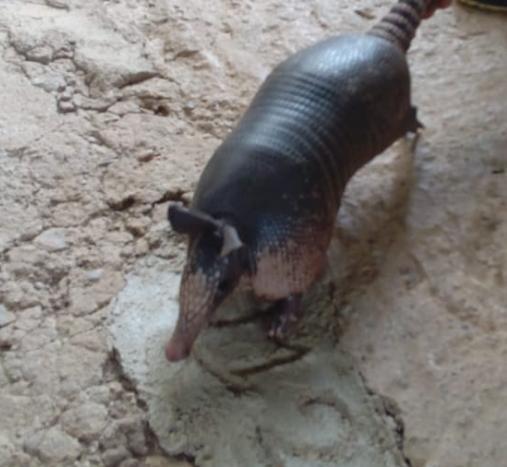
The nine-banded armadillo (Dasypus novemcinctus), also called the nine-banded long-nosed armadillo or common armadillo, is a species of armadillo native to South America. The Mexican long-nosed armadillo of North America was formerly treated as a subspecies of the nine-banded armadillo.
The nine-banded armadillo is a solitary, mainly nocturnal animal, found in many kinds of habitats, from mature and secondary rainforests to grassland and dry scrub. It is an insectivore, feeding chiefly on ants, termites, and other small invertebrates. The armadillo can jump 91–120 cm (3–4 ft) straight in the air if sufficiently frightened, making it a particular danger on roads.
Subspecies
D. n. aequatorialis Lönnberg, 1913
D. n. fenestratus Peters, 1864
D. n. hoplites Allen, 1911
D. n. mexianae (Hagmann, 1908)
D. n. novemcinctus Linnaeus, 1758
Description
Taxidermized armadillo shell
Nine-banded armadillos generally weigh from 2.5–6.5 kg (5.5–14.3 lb), though the largest specimens can scale up to 10 kg (22 lb). They are one of the largest species of armadillos. Head and body length is 38–58 cm (15–23 in), which combines with the 26–53 cm (10–21 in) tail, for a total length of 64–107 cm (25–42 in). They stand 15–25 cm (5.9–9.8 in) tall at the top of the shell. The outer shell is composed of ossified dermal scutes covered by nonoverlapping, keratinized epidermal scales, which are connected by flexible bands of skin. This armor covers the back, sides, head, tail, and outside surfaces of the legs. The underside of the body and the inner surfaces of the legs have no armored protection. Instead, they are covered by tough skin and a layer of coarse hair. The vertebrae attach to the carapace.
The claws on the middle toes of the forefeet are elongated for digging, though not to the same degree as those of the much larger giant armadillo of South America.
Their low metabolic rate and poor thermoregulation make them best suited...