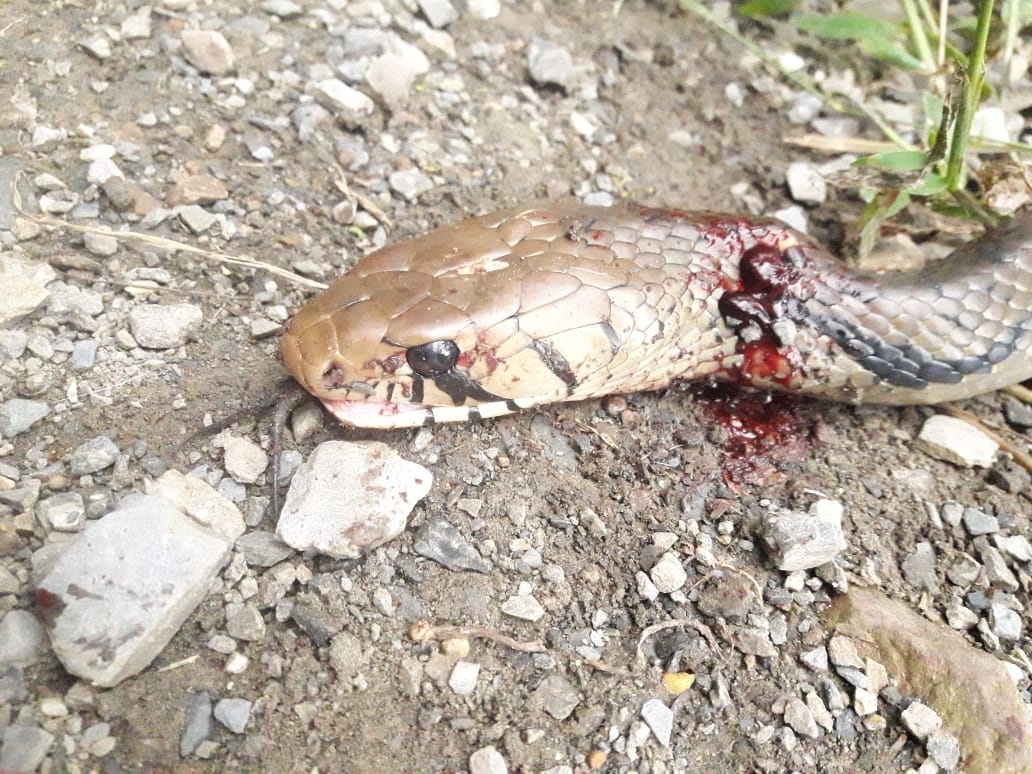
The Colubrinae are a subfamily of snakes within the family Colubridae. It includes numerous genera, and although taxonomic sources often disagree on the exact number, the Reptile Database lists 717 species in 92 genera as of September 2019. It is the second largest subfamily of colubrids, after Dipsadinae. Many of the most commonly known snakes are members of this subfamily, including rat snakes, king snakes, milk snakes, vine snakes, and indigo snakes.
Distribution
Colubrine snakes are distributed worldwide, with the highest diversity in North America, Asia, northern Africa, and the Middle East. There are relatively few species of colubrine snakes in Europe, South America, Australia, and southern Africa, and none in Madagascar, the Caribbean, or the Pacific Islands.
Description
Colubrine snakes are extremely morphologically and ecologically diverse. Many are terrestrial, and there are specialized fossorial (e.g. Tantilla) and arboreal (e.g. Oxybelis) groups, but no truly aquatic groups. Some of the most powerful constrictors (e.g. Pantherophis, Pituophis, Lampropeltis) are members of this group, as are a few snakes that have strong enough venom to kill humans (i.e. boomslangs and twigsnakes ).
Classification
Colubrinae is one of several subfamilies within the family Colubridae, the largest family of snakes. Its phylogeny can be shown in the cladogram below:
body.skin-vector-2022
Colubridae
Sibynophiinae
Natricinae
Pseudoxenodontinae
Dipsadinae
Grayiinae
Calamariinae
Ahaetuliinae
Colubrinae
Within Colubrinae, genera and species seem to make up five distinct radiations that are to varying degrees broadly similar in terms of ecology and geographic distribution, although increased sampling is needed to determine whether all species currently placed in Colubrinae fit into...