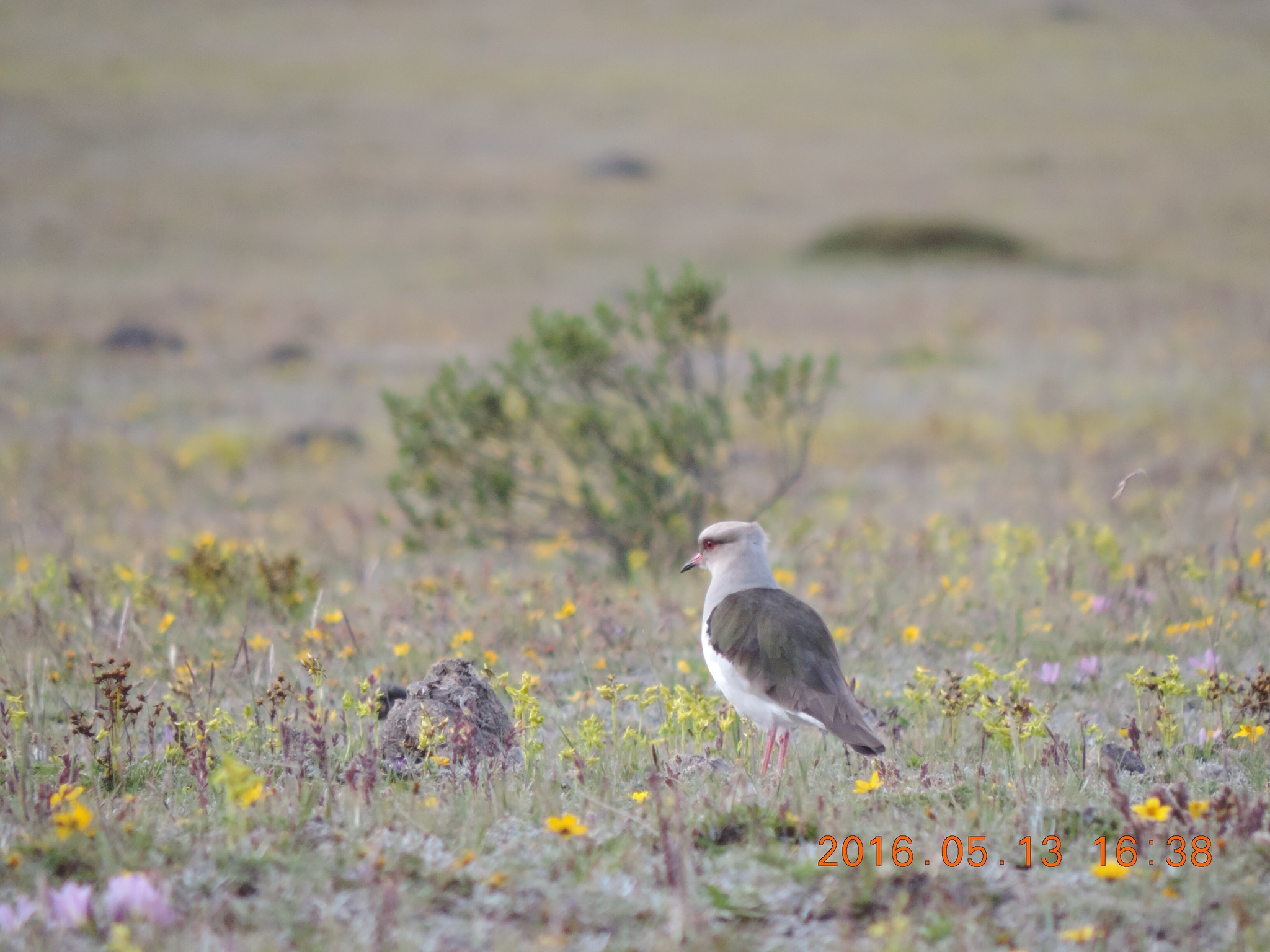
The bird family Charadriidae includes the plovers, dotterels, and lapwings. The family contains 69 species that are divided into 12 genera.
Taxonomy
The family Charadriidae was introduced (as Charadriadæ) by the English zoologist William Elford Leach in a guide to the contents of the British Museum published in 1820. Most members of the family are known as plovers, lapwings or dotterels. These were rather vague terms which were not applied with any great consistency in the past. In general, larger, broader-winged species have often been called lapwings, and the smaller, narrower-winged species plovers or dotterels. Until recently, it was thought these formed two major clear taxonomic sub-groups, with lapwings belonging to the subfamily Vanellinae, and all but one of the plovers and dotterels to Charadriinae; the last one placed in a small third subfamily Pluvianellinae containing only the Magellanic plover. Modern genetic evidence has however shown that this arrangement was polyphyletic, with in particular, many species traditionally placed in the plover genus Charadrius proving more closely related to the lapwings than they were to the type species of that genus, Charadrius hiaticula; as a result, those species have now been split out into the genus Anarhynchus (syn. Ochthodromus). The third former 'subfamily' proved so completely unrelated to the other plovers that it has been removed from the Charadriidae altogether and given its own monotypic family Pluvianellidae, its closest relatives being the strikingly different sheathbills.
The trend in recent years has been to rationalise the common names of the Charadriidae. For example, the large and very common Australian bird traditionally known as the 'spur-winged plover', is now the masked lapwing to avoid conflict with another bird with the same name; and the former 'sociable plover' is now the sociable lapwing.
The following genus-level cladogram is based on a molecular genetic study by David Černý and...