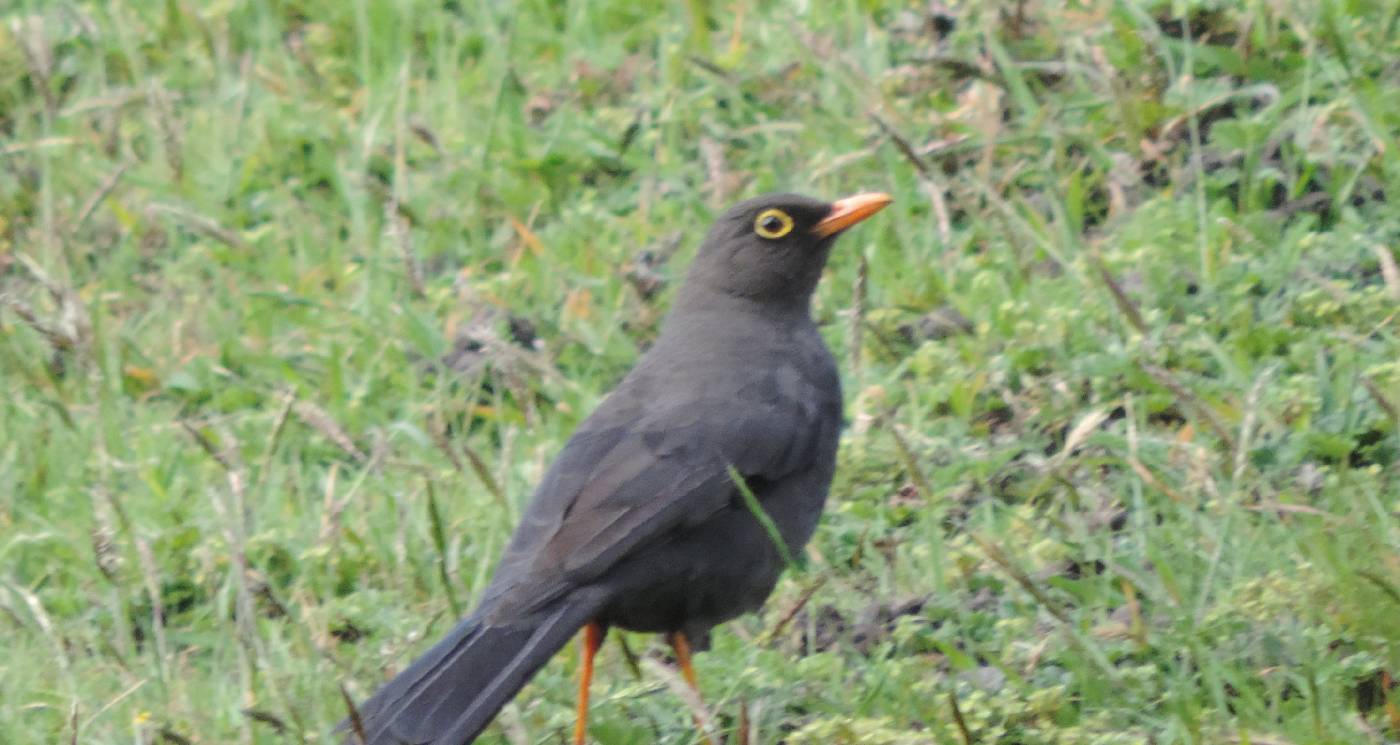
The thrushes are a passerine bird family, Turdidae, with a worldwide distribution. The family was once much larger before biologists reclassified the former subfamily Saxicolinae, which includes the chats and European robins, as Old World flycatchers. Thrushes are small to medium-sized ground living birds that feed on insects, other invertebrates, and fruit. Some unrelated species around the world have been named after thrushes due to their similarity to birds in this family.
Characteristics
Thrushes are plump, soft-plumaged, small to medium-sized birds that inhabit wooded areas and often feed on the ground. The largest thrush is the great thrush at
Thrushes are insectivores, but most species also eat worms, land snails, and fruit (usually berries). Many species are permanently resident in warm climates, while others migrate to higher latitudes during the summer, often over considerable distances.
Thrushes build cup-shaped nests, sometimes lining them with mud. They lay two to five speckled eggs, sometimes laying two or more clutches per year. Both parents help raise the young. In almost all cases, the nest is placed on a branch; the only exceptions are the three species of bluebird, which nest in holes.
Ecology
Turdidae species spread the seeds of plants, contributing to the dispersal of many species and the recovery of ecosystems.
Plants have limited seed dispersal mobility away from the parent plant and consequently rely upon a variety of dispersal vectors to transport their propagules, including both abiotic and biotic vectors. Seeds can be dispersed away from the parent plant individually or collectively, as well as dispersed in both space and time.
Many bats and birds rely heavily on fruits for their diet, including birds in the families Cotingidae, Columbidae, Trogonidae, Turdidae, and Ramphastidae. While eating fruit, these animals swallow seeds and then later regurgitate them or pass them in their faeces. Such ornithochory has been a major...