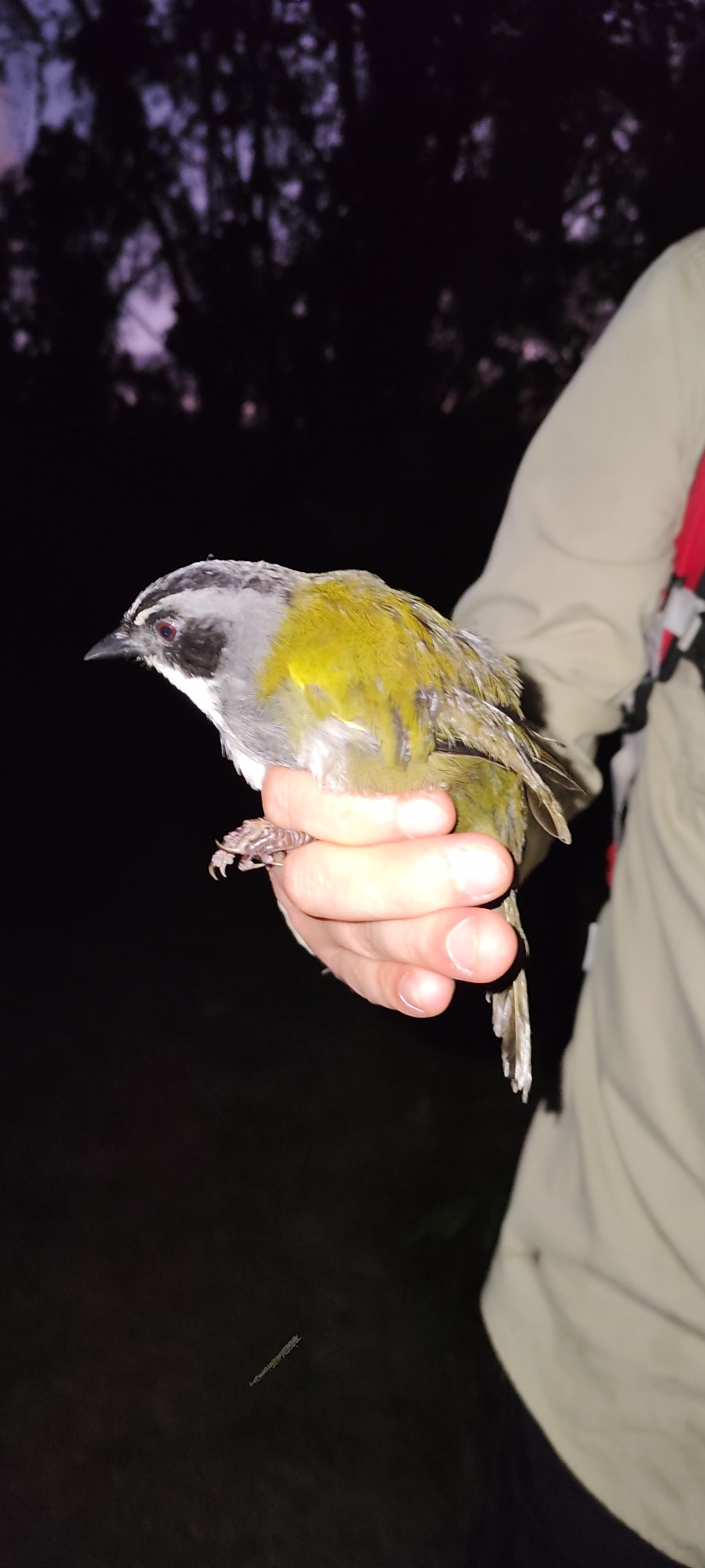
The grey-browed brushfinch (Arremon assimilis) is a species of bird in the family Passerellidae, the New World sparrows. It is found in Colombia, Ecuador, Peru and Venezuela.
Taxonomy and systematics
The grey-browed brushfinch has a complicated taxonomic history. It was formally described in 1840 with the binomial Tanagra (Arrémon, Vieillot; Embernagra, Lesson) assimilis. It was later reassigned to the genus Buarremon that was later merged into genus Atlapetes. Further study resulted in Buarremon's being resurrected. Buarremon assimilis was later reassigned as one of many subspecies of what was then the "stripe-headed brushfinch" (Buarremon torquatus). In 2008 taxonomists began merging Buarremon into Arremon. Following a study published in 2010 and some earlier studies, taxonomists began splitting the "stripe-headed brushfinch" into eight species, one of which was the grey-browed brushfinch.
The grey-browed brushfinch has these four subspecies:
A. a. larensis (Phelps, WH & Phelps, WH Jr, 1949)
A. a. assimilis (Boissonneau, 1840)
A. a. nigrifrons (Chapman, 1923)
A. a. poliophrys (Berlepsch & Stolzmann, 1896)
A 2014 publication suggested that A. a. larensis might be a full species.
Description
The grey-browed brushfinch is 19 to 20 cm (7.5 to 7.9 in) long. The sexes have the same plumage. Adults of the nominate subspecies A. a. assimilis have a black crown with a gray stripe in the middle and a gray supercilium that extends to the nape and wraps down around the back of the ear coverts to the sides of the breast. The rest of their face is black. Their upperparts, wings, and tail are olive-green. Their throat is white that continues through the breast and belly. The sides of their breast and flanks are gray and their vent grayish olive. Juveniles are generally olive with dusky cheeks.
Subspecies A. a. larensis has a wider gray supercilium than the nominate and a black band separating the throat and breast. A. a. nigrifrons' gray crown stripe begins...