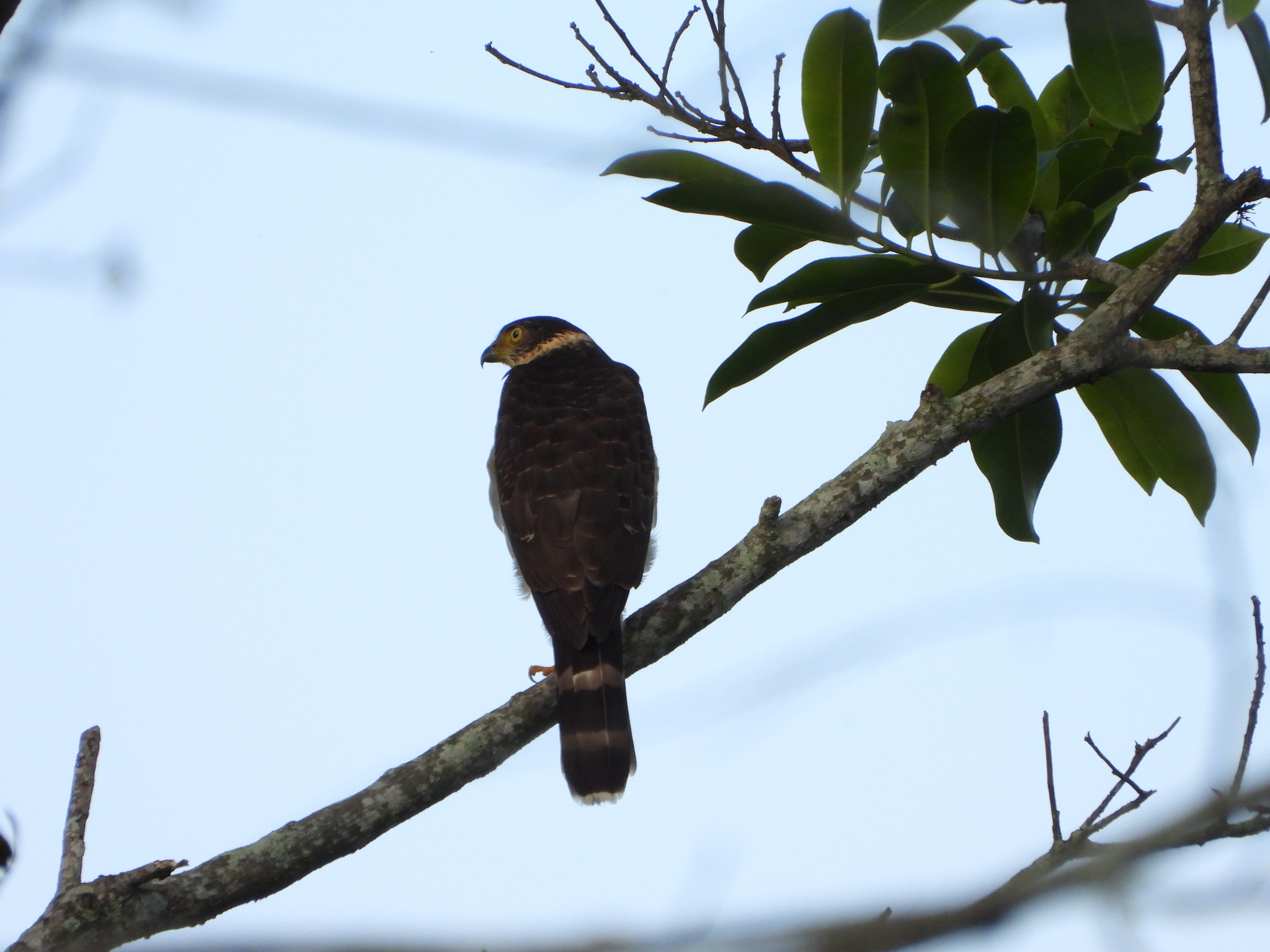
The bicolored hawk (Astur bicolor) is a species of bird of prey in the family Accipitridae. It is found in forest, woodland, second growth, plantations, and wooded savanna in southeastern Mexico, Central America, and northern and central South America (as far south as northern Argentina). Though generally uncommon, it is the most common species of Astur in most of its range, but it does not occur at altitudes above 2,700 metres (8,900 ft) such as the highest parts of the Andes.
Taxonomy
The bicolored hawk was formally described in 1817 by the French ornithologist Louis Vieillot under the binomial name Sparvius bicolor. He specified Cayenne in French Guiana as the type locality. The bicolored hawk was formerly placed in the large and diverse genus Accipiter. In 2024 a comprehensive molecular phylogenetic study of the Accipitridae confirmed earlier work that had shown that the genus was polyphyletic. To resolve the non-monophyly, Accipiter was divided into six genera. The genus Astur was resurrected to accommodate 9 species, including the bicolored hawk, that had previously been placed in Accipiter. The resurrected genus had been introduced in 1799 by the French naturalist Bernard Germain de Lacépède. The genus name is from Latin astur, asturis meaning "hawk".
The bicolored hawk is also closely related to the Cooper's hawk (A. cooperii) and Gundlach's hawk (A. gundlachi); these three form a superspecies. Until recently, the Chilean hawk (A. chilensis) from the colder, southernmost South America was treated as a race of A. bicolor but due to its differences in habitat preferences and plumages from the bicolored hawk, A. chilensis is now considered a full species.
Four subspecies are recognised:
A. b. bicolor (Vieillot, 1817) – found in Southeastern Mexico and south through northern South America. Adults have a black crown, slate upper parts and a blackish tail that displays two or three pale bars. The primaries are obscurely...