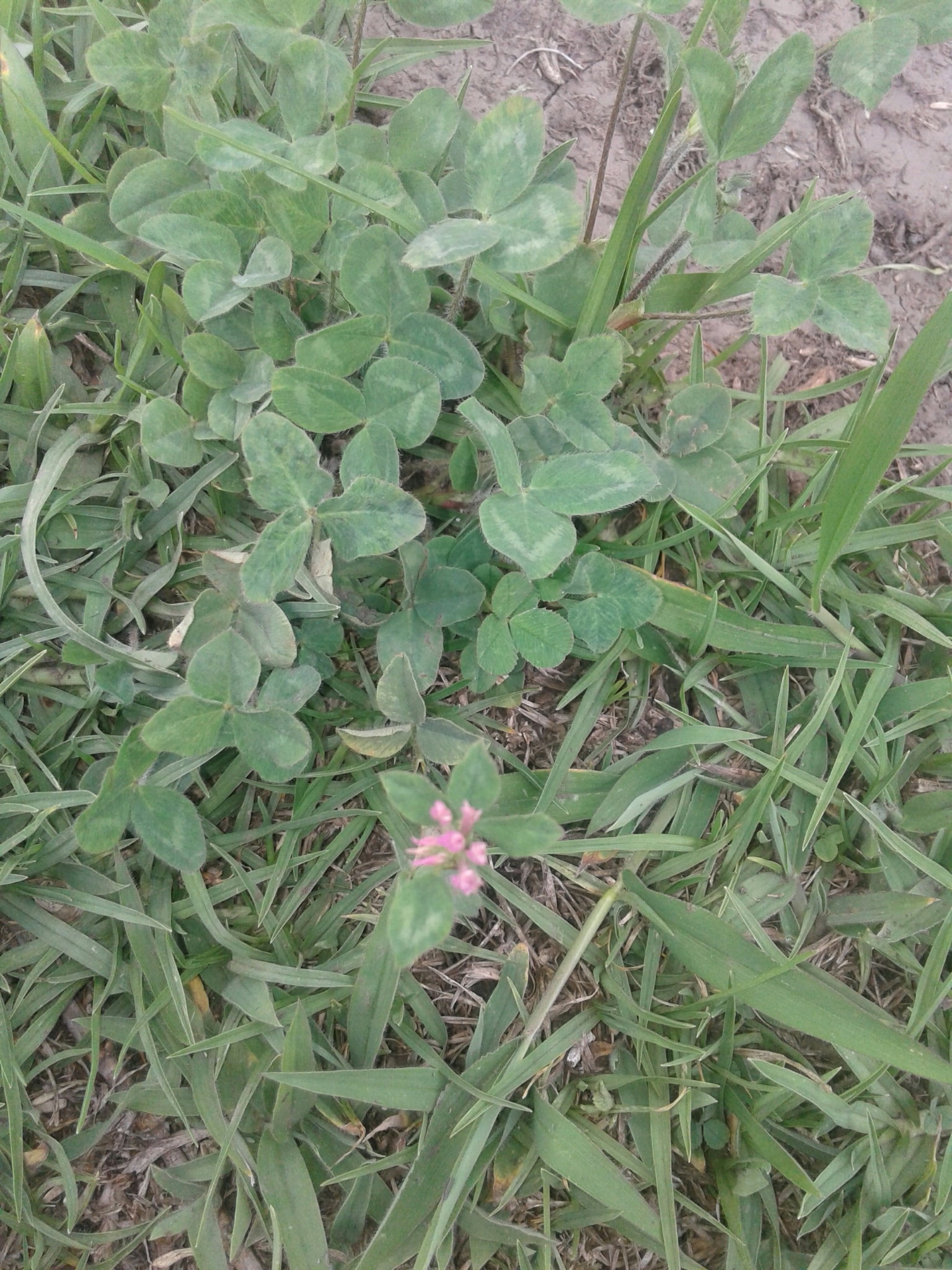
Clovers, also called trefoils, are plants of the genus Trifolium (from Latin tres 'three' and folium 'leaf'). They are herbaceous plants growing up to 30 cm (12 in) tall. The leaves are usually trifoliate and the small flowers are reddish to white or yellow. Related genera with similar common names include Melilotus (sweet clover) and Medicago (burclover).
The genus consists of about 300 species in the legume family, Fabaceae. Originating in Europe, the genus has a cosmopolitan distribution. A number of wild and domestic animals consume the plants. Clovers have been cultivated by humans for over 1,000 years, valued for their nitrogen fixation, which fertilizes the soil and bolsters the productivity of rotated crops.
Some forms of the plant are culturally significant, including the shamrock, used to represent Ireland, and the four-leaf clover, associated with good luck. Specimens with other numbers of leaflets have been found, the record high of 63 being recorded in 2023.
Description
They are small annual, biennial, or short-lived perennial herbaceous plants, typically growing up to 30 cm (12 in) tall. The leaves are trifoliate, but seldomly have more or less than three leaflets, being more rare the higher or lower the number. The stipules are adnate to the leaf-stalk. Small red, purple, white, or yellow flowers appear in heads or dense spikes. The small, few-seeded pods are enclosed in the calyx.
Other closely related genera often called clovers include Melilotus (sweet clover) and Medicago (burclover), including the species alfalfa and Calvary clover.
@media all and (max-width:720px){
Trifolium dubium (lesser hop trefoil)
Flower and leaves of T. alpestre (owl-head clover)
Top of Trifolium repens (white clover) leaf showing leaf structure and characteristics.
Bottom of Trifolium repens (white clover) leaf.
Bottom of clover leaf showing epidermal cells and stomata.