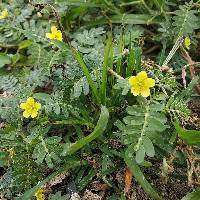
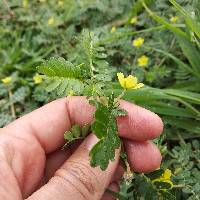
Tribulus terrestris is an annual plant in the caltrop family (Zygophyllaceae) widely distributed around the world. It is adapted to thrive in dry climate locations in which few other plants can survive, and is a highly invasive species.
Native to warm temperate and tropical regions in southern Eurasia and Africa, it has been unintentionally introduced to North America and Australia. T. terrestris is widely known as a noxious weed because of its small woody fruit – the bur – having long sharp and strong spines which easily penetrate surfaces, such as bare feet or thin shoes of crop workers and other pedestrians, the rubber of bicycle tires, and the mouths and skin of grazing animals.
Common names
Like many weedy species, this plant has numerous common names according to the world region, including puncture vine, goathead, bullhead, calthrop, devil's thorn, sandbur, and burnut.
Description
Tribulus terrestris habitus on a beach in the Philippines
Tribulus terrestris is a taprooted herbaceous plant that grows as a summer annual in temperate climates.
The stems radiate from the crown to a diameter of about 10 cm (4 in) to over 1 m (3 ft 3 in), often branching. They are usually prostrate, forming flat patches, though they may grow more upwards in shade or among taller plants.
"Goathead" fruit
Germinating fruit of Tribulus terrestris
Dried Tribulus terrestris burs
Stems branch from the crown and are densely hairy. Leaves are opposite and pinnately compound. Densely hairy leaflets are opposite and up to
The flowers are 4–10 mm (3⁄16–3⁄8 in) wide, with five lemon-yellow petals, five sepals, and ten stamens. In Southern California, it blooms from April through October, where it is highly invasive in waste places and disturbed sites.
Thumbtack-like Tribulus terrestris burs are a hazard to bare feet and bicycle tires.
After the flower blooms, a fruit develops that easily falls apart into five burs....