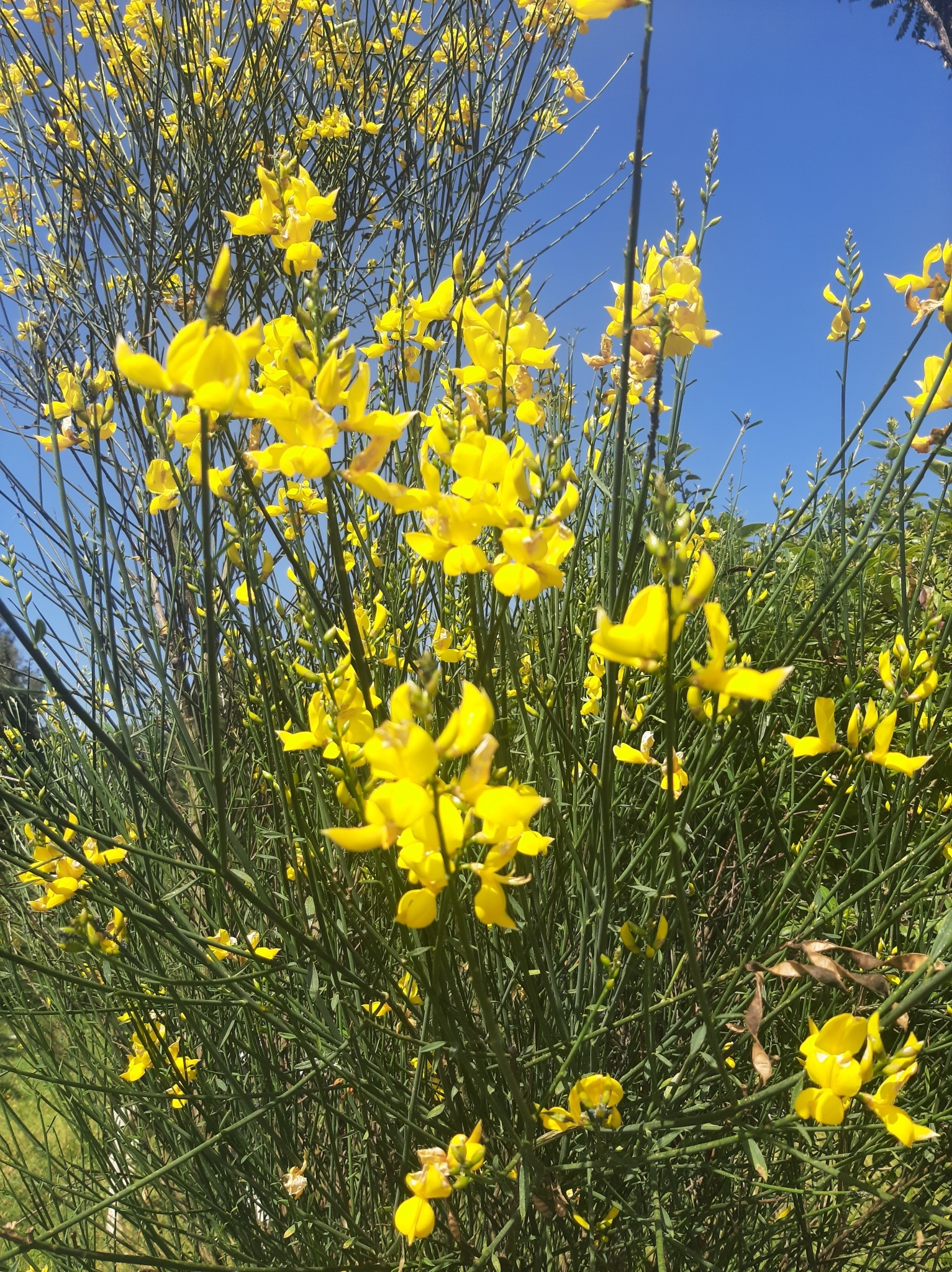
Spartium junceum, known as Spanish broom, rush broom, or weaver's broom, it is a species of flowering plant in the family Fabaceae and the sole species in the genus Spartium. It is closely related to the other brooms (in the genera Cytisus and Genista).
Description
Spartium junceum is a vigorous, deciduous shrub growing to 2–4 metres (7–13 feet) tall, rarely 5 m (16 ft), with main stems up to 5 centimetres (2 inches) thick, rarely 10 cm (4 in). It has thick, somewhat succulent grey-green rush-like shoots with very sparse small deciduous leaves
Taxonomy
The Greek name Spartium given to the genus denotes the use of the plant for 'cordage'. The Latin specific epithet junceum means "rush-like", referring to the shoots, which show a passing resemblance to those of the rush genus Juncus.
Distribution and habitat
This species is native to the Mediterranean in southern Europe, southwest Asia and northwest Africa, where it is found in sunny sites, usually on dry, sandy soils.
Spartium junceum has been widely introduced into other areas, and is regarded as a noxious invasive species in places with a Mediterranean climate such as California and Oregon, Hawaii, central Chile, southeastern Australia, the Western Cape in South Africa and the Canary Islands and Azores. It was first introduced to California as an ornamental plant.
As an invasive species
Spartium junceum has been widely introduced into other areas, and is regarded as a noxious invasive species in places with a Mediterranean climate such as California and Oregon, Hawaii, central Chile, southeastern Australia, the Western Cape in South Africa and the Canary Islands and Azores. It was first introduced to California as an ornamental plant.
Toxicity
Few cases have been described of intoxication by the S. junceum, including accidental ingestion of different parts of the plant by children. The alkaloids found in all parts of the plant have toxic effects. They initially provoke a transitory stimulation of nicotinic cholinergic...