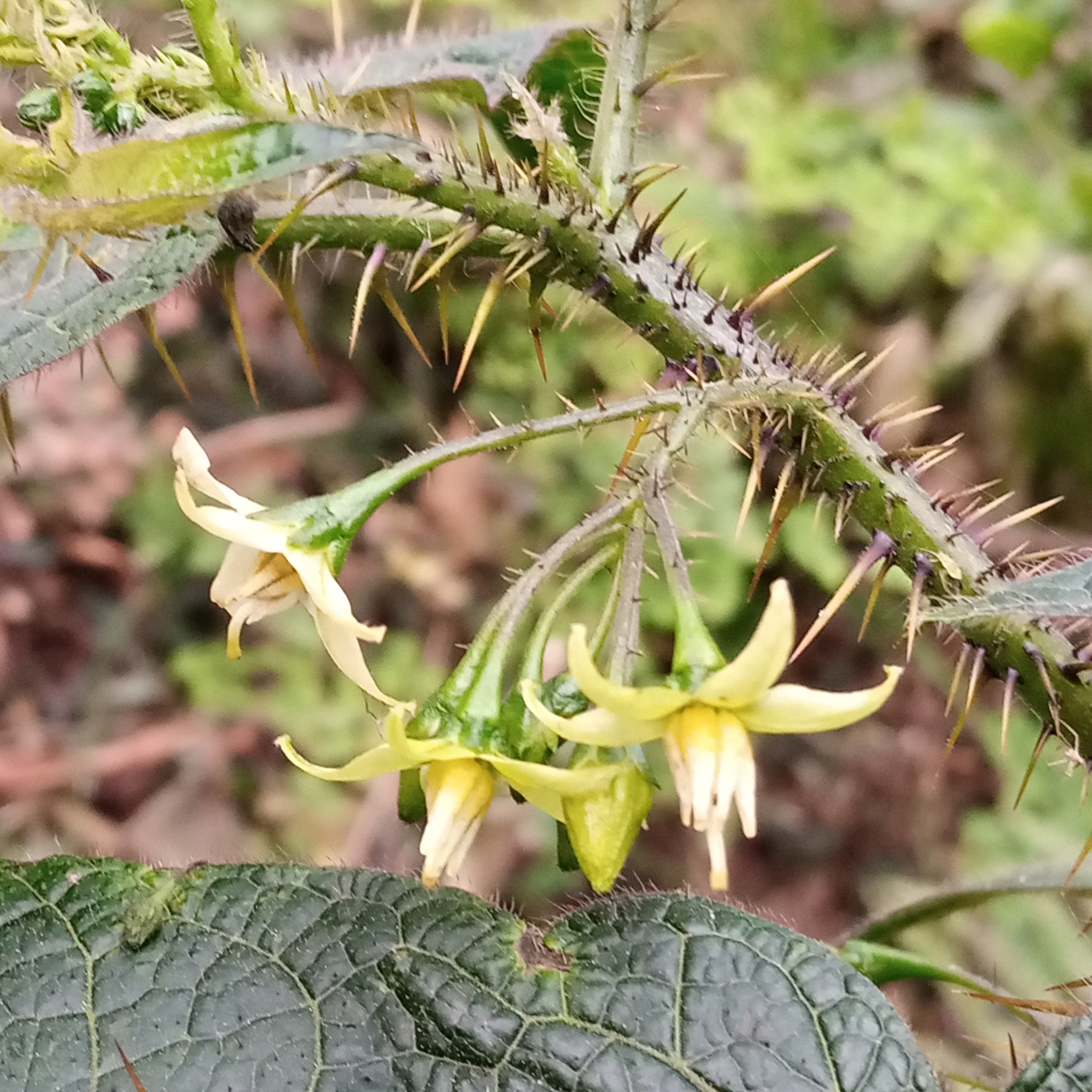
Solanum acerifolium is a species of small flowering shrub that belongs to the Solanaceae family, commonly known as the nightshade family. The species description was first published by a French botanist, Michel Félix Dunal in 1816.
Description
Solanum acerifolium is a herbaceous plant that stands upright and is typically found reaching heights between 0.5 to 3 m (1 ft 8 in to 9 ft 10 in) in height, usually growing for a single stem but occasionally multiple coming from the base. Stems are pubescent with viscid-villous hairs and prickles that are straight and acicular. Acicular prickles appear densely armed along all parts of the stem. Prickles are usually 0.1 to 1.5 centimeters in length. Upper flowering branches usually carry fewer prickles and appear more glabrous except for the viscid-villous hairs.
Leaves on S. acerifolium are around 5 to 18 cm (2.0 to 7.1 in) long and 4 to 15 cm (1.6 to 5.9 in) wide. Leaves can be single or in pairs. Leaves are broadly ovate or elliptic in shape and are usually 4-lobed with an acute apex. On both surfaces of the leaves are pubescent, and covered in viscid-villous hairs. Both surfaces of the leaves carry prickles along the major veins, similar in size to those found along the stems. The petioles of leaves measure 4 to 9 cm (1.6 to 3.5 in) and have a pubescence similar to that of stems.
Inflorescence found on the S. aceriolium is extra-axillary and unbranched measuring 6 to 40 mm (0.24 to 1.57 in). The inflorescence is characterized as a subumbellate raceme. Typically holding 3 to 10 flowers that develop 1 to 8 fruit. The peduncles are pubescent, similar to the stem with few prickles, less than 5 mm (0.20 in) long, and sometimes absent. Peduncles measure from 0.5 to 3.5 cm (0.20 to 1.38 in) and rachis of the inflorescence measure up to 1 cm (0.39 in) long. The pedicles are 8 to 15 mm (0.31 to 0.59 in) in length for...