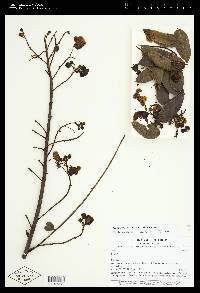
Senna spectabilis is a plant species of the legume family (Fabaceae) in the subfamily Caesalpinioideae native to South and Central America. They are often grown as an ornamental in front yards, parks, gardens, buildings etc. due to their bright yellow flowers that bloom during the summer months. They are also known as golden wonder tree, American cassia, popcorn tree, Cassia excelsa, golden shower tree or Archibald's cassia.
The plant has become an invasive alien species in parts of Africa such as Kenya, Malawi, Tanzania and Uganda, and also in South-India, after it was introduced for resources such as firewood as well as to help combat deteriorating ecosystems affected by deforestation and desertification. Currently, S. spectabilis is overtaking native tree species of forestry ecosystems around the world because of its ability to grow quickly.
Description
Senna spectabilis
Senna spectabilis is a shrub or deciduous tree that can grow anywhere from 15 to 20 ft in height and 15–20 ft in width. S. spectabilis have a rounded vase-shaped crown, which is dense and symmetrical. S. spectabilis is pollinated by bees and has a very fast growth rate.
A rounded, evergreen foliage, arranged alternatively. The leaf type is odd-pinnately compound with pinnate leaf venation and 4–15 pairs of leaflets each growing to as large as 7.5 cm. The leaves are green and yellow in color and remains as so year around. The leaf blades grow between 2–4 inches long and experience a circadian rhythm or nyctinasty, closing at night and opening at dawn.
Flowers of Senna spectabilis
Senna spectabilis fruit pod
Bright yellow inflorescence 10–50 cm long containing a corolla 3.5–4 cm in diameter with five unequal petals. The flowers are very showy producing elongated pod shaped fruits about 6–12 inches in length. The fruit is a dry dehiscent, black/brownish in color containing numerous flat brown seeds, 0.5 cm in diameter.