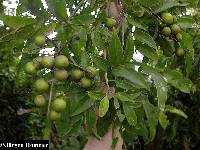
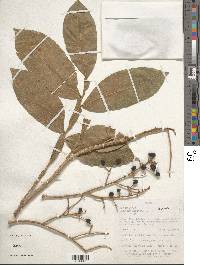
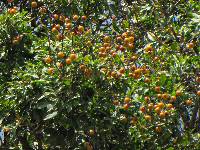
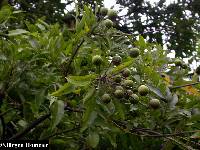
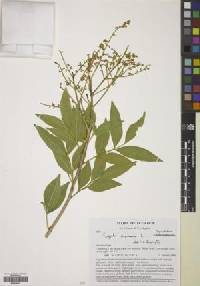
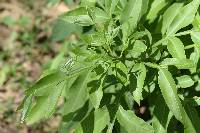
Sapindus saponaria is a small to medium-sized deciduous tree native to the Americas. Common names include rocky mountain maple, wingleaf soapberry, western soapberry, jaboncillo, sulluku and manele and a'e (Hawaiian). Its genus name, Sapindus, comes from the Latin, meaning Indian soap, and its specific epithet means "soapy".
Western Soapberry is a member of the maple family of trees.
Although western soapberry lumber is not harvested commercially due to its rarity, it was highly esteemed in the recent past by indigenous ethnic groups like the Plains Apache, for its hardness and resilience.
Western soapberry is classified as a "least concern" species, and due to its hardiness, it thrives in regions with poor soil and extreme drought. However, agricultural development threatens the existence of certain local communities in south-central Oklahoma.
The fruit of western soapberry is mildy toxic if ingested orally, due to the high saponin content. The high saponin content also allows for the fruit to be used as a form of lathering soap. Despite the mild oral toxicity, the fruits of soapberry species may have topical health benefits.
Taxonomy
Plants of the World Online
body.skin-vector-2022
Sapindus
'S. saponaria var. saponaria (syn. S. marginatus) Willd.
S. saponaria var. inaequalis Radlk.
S. saponaria var. jardiniana F.Br.
'S. saponaria var. thurstonii (Rock) Skottsb.
Note: "Sapindus saponaria is a synonym of the restored species Sapindus drummondii. It is called "Western soapberry" and is native from Arizona to Louisiana in the south ranging north to Kansas and far southwestern Missouri in the north. It is also native to the states of Sonora, Chihuahua, and Coahuila in Mexico.
Distribution
This species has a very wide native range throughout the Americas, ranging from Kansas (with isolated populations known as far north as Montana, Colorado, and Missouri) east to Florida and...