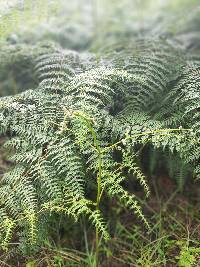
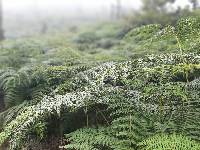
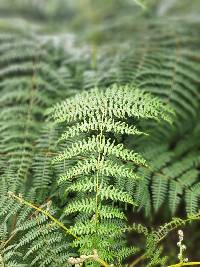
Pteridium aquilinum, commonly called bracken, brake, pasture brake, common bracken, and also known as eagle fern, is a species of fern occurring in temperate and subtropical regions in both hemispheres. Originally native to Eurasia and North America, the extreme lightness of its spores has led to it achieving a cosmopolitan distribution. It is a herbaceous perennial plant with large, triangular fronds that grow from an underground rhizome.
Description
Common bracken is a herbaceous perennial plant, deciduous in winter. The large, roughly triangular fronds are produced singly, arising upwards from an underground rhizome, and grow to
Amphicribral vascular bundle of a common bracken rhizome
Diagram of the plant's leaves
Leaves of a P. aquilinum plant
Sporangia are formed in sori on the underside of the frond. They are arranged in narrow brown bands, and form spores over July, August and September.
Reproduction
Sporangia are formed in sori on the underside of the frond. They are arranged in narrow brown bands, and form spores over July, August and September.
Taxonomy
It was traditionally treated as the sole species in the genus Pteridium (brackens); however, authorities have split and recognised up to 11 species in the genus. It was placed in the genus Pteridium by Friedrich Adalbert Maximilian Kuhn in 1879. Genetic analysis of Pteridium from 100 different locations worldwide has revealed two distinct species and despite the common name "bracken" being shared, the "southern" species is Pteridium esculentum. Though the southern P. esculentum shows little genetic diversity among physically isolated locations, P. aquilinum has distinct groups at the continental scale. However, evidence of long-distance gene flow was found in samples taken from Hawaii that presented elements of both North American and Asian subspecies of P. aquilinum.
Common bracken was first described as Pteris aquilina by Carl Linnaeus, in Volume 2 of his Species...