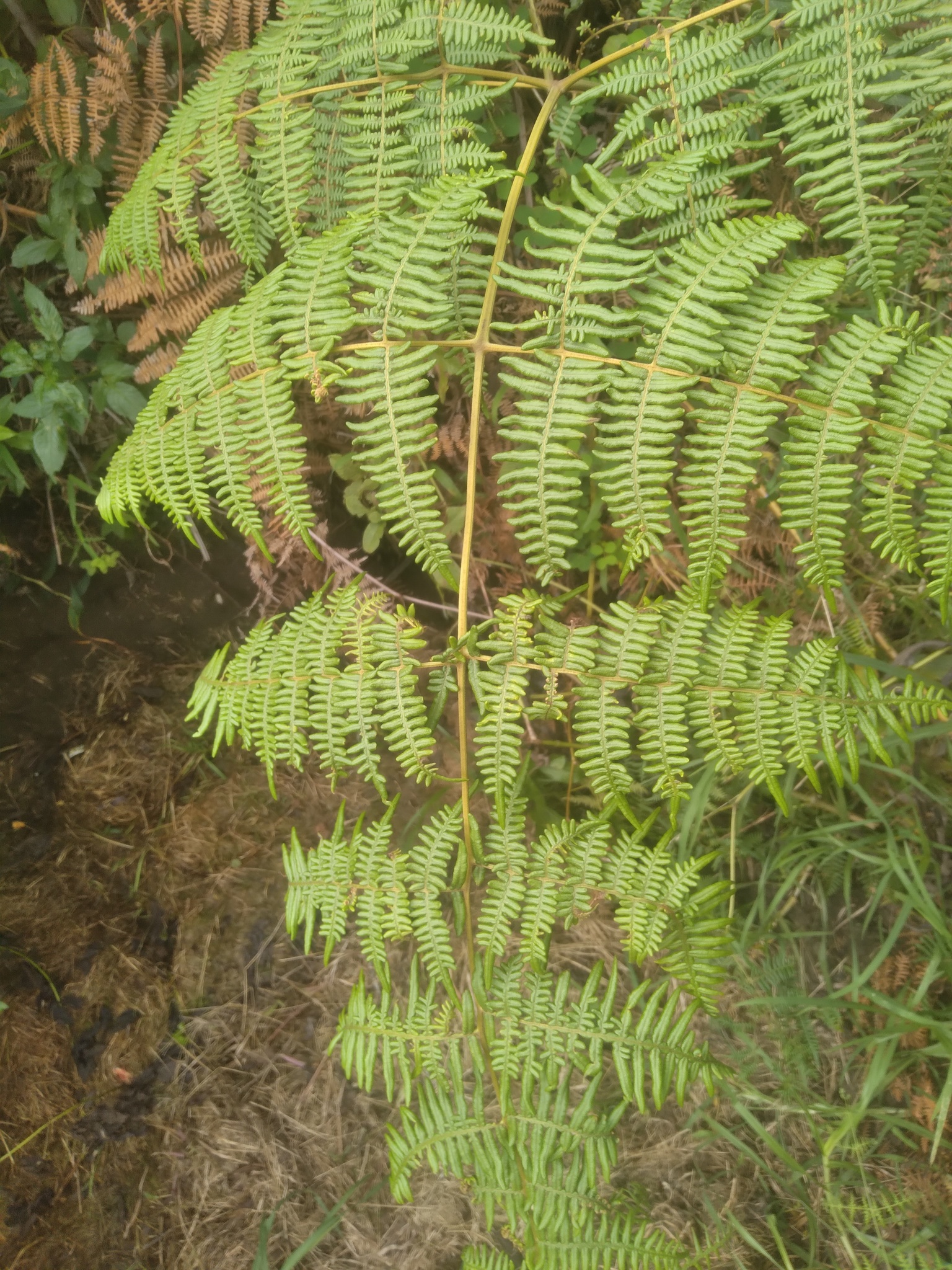
Bracken (Pteridium) is a genus of large, cosmopolitan, coarse ferns in the family Dennstaedtiaceae. Brackens are noted for their large, highly divided fronds and are found on all continents except Antarctica; their typical habitat is moorland. The word bracken is of Old Norse origin, related to Swedish bräken and Danish bregne, both meaning fern. In the past, the genus was commonly treated as having only one species, Pteridium aquilinum, but the current trend is to subdivide it into about ten species. Like other ferns, brackens reproduce by spores rather than seeds or fruit. The immature fronds, known as fiddleheads, are sometimes eaten, although some contain carcinogenic compounds.
Description
Sori (paler green) along outer edge on underside of leaves
Bracken is one of the oldest ferns, with fossil records from the Eocene period 55 million years old having been found. The plant sends up large, triangular fronds from a wide-creeping underground rootstock, and may form dense thickets. This rootstock may travel a metre or more underground between fronds. The fronds may grow up to 2.5 m (8 ft) long or longer with support, but typically are in the range of
Fern spores are contained in structures found on the underside of the leaf called sori. The sori of bracken are located in a line next to the leaf-edge and are distinctly different from those in most other ferns, where the sori are circular and occur towards the centre of the leaf.
Species
As of August 2026, Plants of the World Online accepted 20 species:
Image
Scientific name
Distribution
Pteridium aquilinum (L.) Kuhn
Macaronesia, N. & NE. Tropical Africa, Arabian Peninsula, Europe to Siberia and Iran
Pteridium arachnoideum (Kaulf.) Maxon
Mexico to Tropical America
Pteridium brownseyi Fraser-Jenk.
Pakistan to W. Himalaya
Pteridium campestre (Schrad.) Christenh.
S. Tropical America.
Pteridium capense (Thunb.) Krasser
Africa.
Pteridium caudatum (L.) Maxon
Tropical &...