Lucuma bifera (synonym Pouteria lucuma) is a species of tree in the family Sapotaceae cultivated for its fruit, the lúcuma. It is native to the Andean valleys of South America.
Description
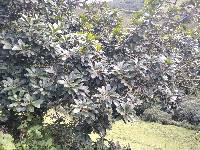
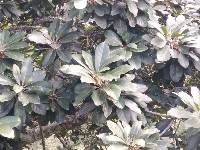
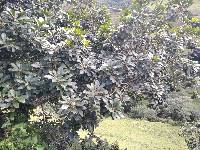
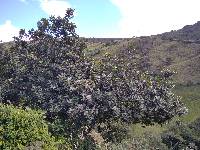
This evergreen tree is up to 20 metres (66 feet) tall and has grayish-brown, fissured bark, which produces a milky white exudate. The end of branchlets and the petioles are covered with short, brown hairs. The leaves are simple, oblanceolate to elliptical, up to 25 centimetres (10 inches) long and 10 cm (4 in) wide, and glabrous (or sometimes slightly hairy on the underside) grouped at the end of the branches.
The flowers are solitary or in fascicles, small, axillary, with hairy sepals and a corolla forming a tube
@media all and (max-width:720px){
Lúcumas
Distribution and habitat
L. bifera is native to the Andean valleys of Colombia, Ecuador, Peru, Bolivia, and northern Chile, at temperate elevations of 2,700–3,000 m (8,900–9,800 ft).
Europeans first reported seeing the fruit in Ecuador in 1531.
Cultivation
In addition to Peru, the fruit is grown also to a limited extent in Bolivia, Chile, and Costa Rica. Attempts at growing lúcuma in Florida's climate are typically not successful. The fruit is successfully grown in Vietnam, where it is known as lêkima.
In Peru, harvesting season is from October to March and in Chile from June to November.
@media(min-width:640px){
Fat0.5 %
Protein1.5 %
Vitamins and minerals
VitaminsQuantity %DVVitamin A2.3 IUThiamine (B1)1% 0.01 mgRiboflavin (B2)11% 0.14 mgNiacin (B3)12% 1.96 mgVitamin C2% 2.2 mg
MineralsQuantity %DVCalcium1% 16 mgIron2% 0.4 mgPhosphorus2% 26 mgPotassium16% 470 mgSodium0% 6 mg
Other constituentsQuantityWater64.8 - 72.3 %
Percentages estimated using US recommendations for adults, except for potassium, which is estimated based on expert recommendation from the National Academies.