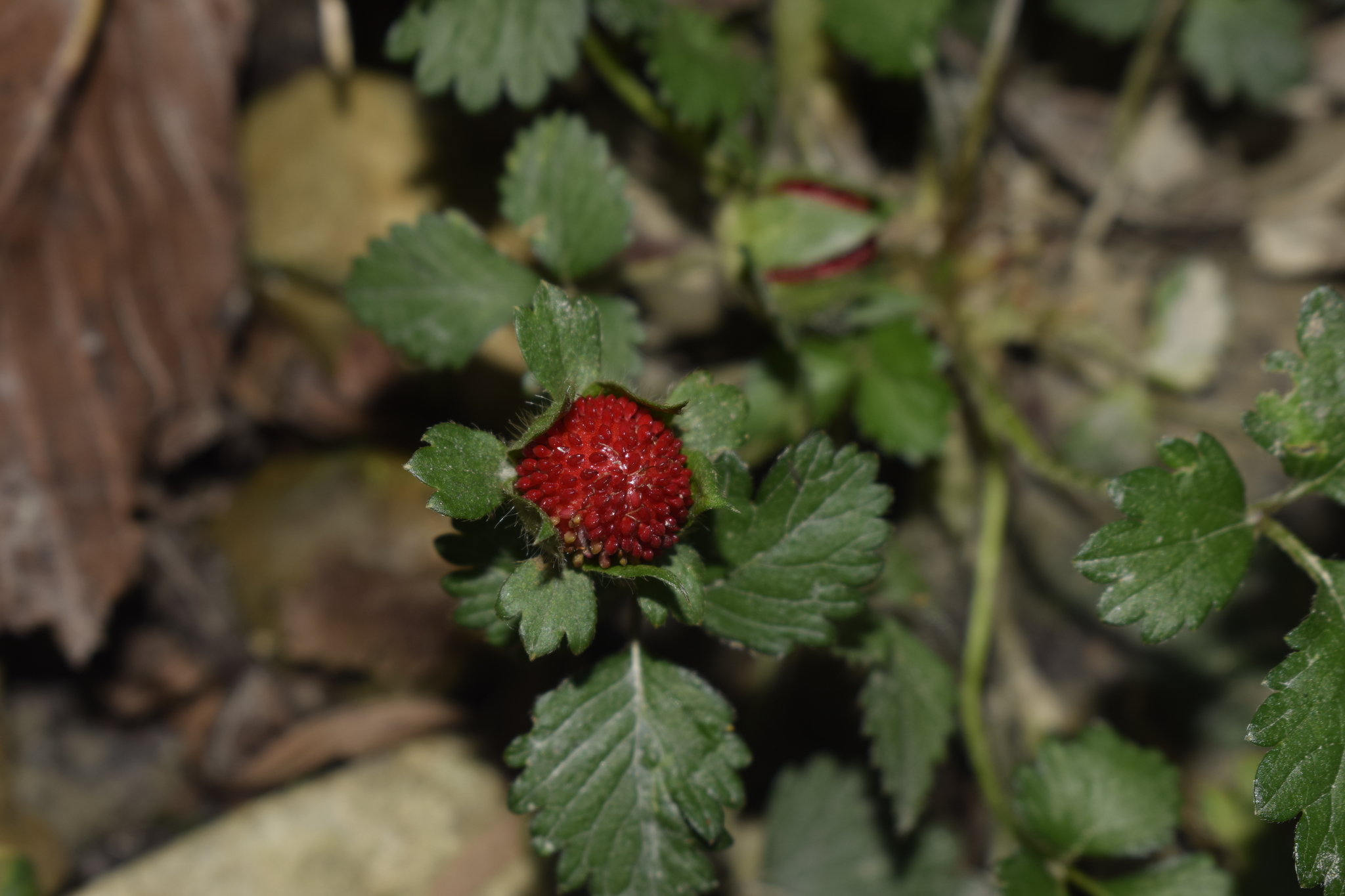
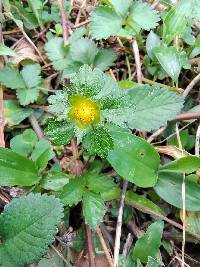
Potentilla indica, known commonly as false strawberry, mock strawberry, or Indian strawberry, (also snakeberry in North America) is a flowering plant in the family Rosaceae, native to West Asia to India, East Asia, and Southeast Asia. It has ternate foliage and an aggregate accessory fruit, similar to true strawberries of the genus Fragaria. Unlike the white or slightly pink flowers of true strawberries, Potentilla indica has yellow flowers, as do many other Potentilla species. It is native to eastern and southern Asia, but has naturalized in many regions worldwide. P. indica is an introduced species in the United States and Canada, often noticed as a weed on grass lawns.
Many sources consider this plant part of the genus Potentilla due to evidence from chloroplast genetic sequence data that the genus Duchesnea is included within Potentilla, though some still list it as Duchesnea indica.
Description
Potentilla indica bloom
The herbaceous plant spreads along creeping stolons, rooting and producing plantlets at each node. The leaves are trifoliate, dark green, and somewhat thick. The flowers are produced singly on axillary peduncles. The yellow petals of Potentilla indica have a nectar guide near the center of each petal that absorbs UV light more strongly than the rest of the petal and is visible only in the UV spectrum. The most common variety, Potentilla indica var. indica, has fruiting receptacles and achenes that are red and glossy. The rare variety D. indica f. albocaput Naruh., with white receptacles and cream achenes, has been reported only in Argentina and Japan.
@media all and (max-width:720px){
Blossom
Mature fruit
Dried fruits
Invasiveness
Mock strawberry is considered invasive in some regions of the United States, where it may disrupt local ecosystems. Studies have shown that it can negatively impact the abundance of springtails and ants, affecting soil biodiversity.