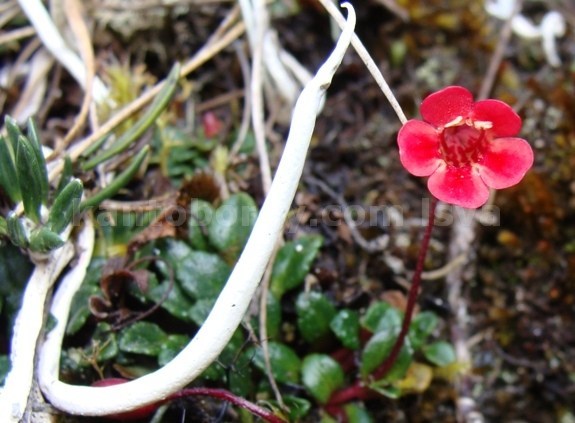
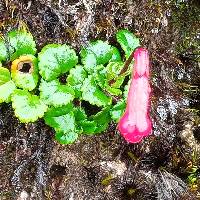
Ourisia chamaedrifolia is a species of flowering plant in the family Plantaginaceae that is endemic to páramo habitats in the Tropical Andes mountains of Venezuela, Colombia, Ecuador, Peru and Bolivia. George Bentham described O. chamaedrifolia in 1846. Plants of this species of South American foxglove are small, perennial, and repent herbs with opposite, crenate, and often hairy leaves. There can be up to four flowers on a short raceme, and each flower has a regular calyx, and a long, tubular, red or orange-red nearly bilabiate corolla with exserted stamens. The calyx and corolla are often hairless.
Taxonomy
Ourisia chamaedrifolia Benth. is in the plant family Plantaginaceae. British botanist George Bentham described O. chamaedrifolia in Augustin Pyramus de Candolle's 1846 publication, Prodromus.
The type material was collected by Scottish-Ecuadorian botanist William Jameson on Pichincha in Ecuador. The lectotype was designated by Heidi Meudt and is housed as part of the de Candolle collection at the herbarium of the Geneva Botanical Garden (Herbarium G).
Ourisia chamaedrifolia var. elegans and O. rupicola were both described by French botanist Hugh Algernon Weddell and both are synonyms of O. chamaedrifolia.
Ourisia chamaedrifolia is one of five species of Ourisia in the Tropical Andes, together with O. muscosa, O. pulchella, O. biflora, and O. cotapatensis. All five species are in the herbaceous subgenus Ourisia. Of these, O. chamaedrifolia is distinctive in its long, red or orange-red, glabrous, tubular corollas. Although the pollination biology of O. chamaedrifolia has not been studied, the colour, shape and vertical orientation of its corollas suggests hummingbird pollination.
Description
Ourisia chamaedrifolia plants are perennial, repent herbs. The trailing, branching stems are 1.2–2.9 mm wide, and glabrous (hairless) or hairy with short non-glandular hairs. Leaves are tightly clustered, often tufted near the growing tip of the stem,...