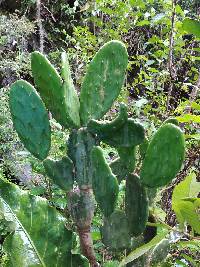
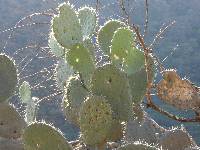
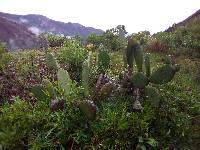
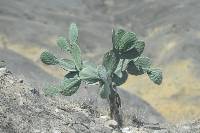
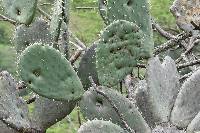
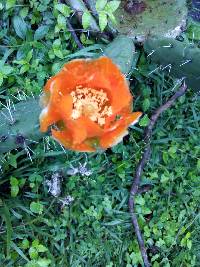
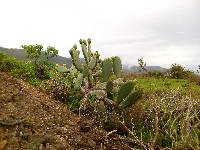
Opuntia ficus-indica, the Indian fig opuntia, fig opuntia, or prickly pear, is a species of cactus that has long been a domesticated crop plant grown in agricultural economies throughout arid and semiarid parts of the world. O. ficus-indica is the most widespread and most commercially important cactus. It is grown primarily as a fruit crop, and also for the vegetable nopales and other uses. Cacti are good crops for dry areas because they efficiently convert water into biomass. O. ficus-indica is the most widespread of the long-domesticated cactuses. Opuntia species hybridize easily, but the wild origin of O. ficus-indica is likely to have been in central Mexico, where its closest genetic relatives are found.
Names
Most culinary references to the "prickly pear" refer to this species. The Spanish name tuna is also used for the fruit of this cactus and for Opuntia in general; according to Alexander von Humboldt, it was a word of Taino origin taken into the Spanish language around 1500.
Common English names for the plant and its fruit are Indian fig opuntia, Barbary fig, cactus pear, prickly pear, and spineless cactus, among many others. In Mexican Spanish, the plant is called nopal, a name that may be used in American English as culinary terms. Peninsular Spanish mostly uses higo chumbo for the fruit and chumbera for the plant.
In Greek, the plant is called φραγκοσυκιά and the fruit φραγκόσυκο, literally "Frankish fig", a label historically applied to foreign produce. In Cyprus, the fruits are commonly known as παπουτσόσυκα and the plant as παπουτσοσυκιά; the name is glossed in Cypriot dialect sources and popularly explained as "shoe figs" in reference to the thick, shoe-like pads.
Description
Flower
Fruit
O. ficus-indica is polyploid, hermaphroditic, and autogamous. As Opuntia species grow in semiarid environments, the main limiting factor in their environment is water. They have developed several adaptations to dry...