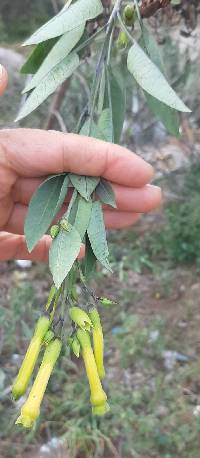
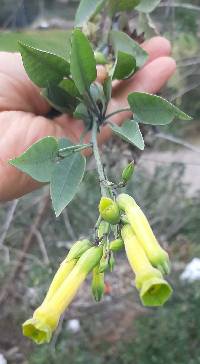
Nicotiana glauca is a species of flowering plant in the tobacco genus Nicotiana of the nightshade family Solanaceae. It is known by the common name tree tobacco. Its leaves are attached to the stalk by petioles (many other Nicotiana species have sessile leaves), and its leaves and stems are neither pubescent nor sticky like Nicotiana tabacum. It resembles Cestrum parqui but differs in the form of leaves and fusion of the outer floral parts. It grows to heights of more than two meters.
Tree tobacco is native to South America but it is now widespread as an introduced species on other continents. It is a common roadside weed in the southwestern United States, and an invasive plant species in California native plant habitats.
Description
Nicotiana glauca is a small tree or shrub with many branches that normally grows to over 2 m, but can reach as high as 7 m. Its ample leaves can be up to 20 cm long, oval-shaped, bluish-green in color with a thick and rubbery texture. It has yellow to greenish-yellow tubular flowers about 5 cm long and 1 cm wide, growing loosely at the ends of branches. The plant primarily reproduces by seed.
Ecology
Nicotiana glauca can pose a threat to native species by outcompeting them for resources and is classified as an invasive species in many parts of the world. In some management programmes, the beetle Malabris aculeata has been successfully deployed as a biological control agent. Every part of the plant is potentially poisonous to humans and livestock.