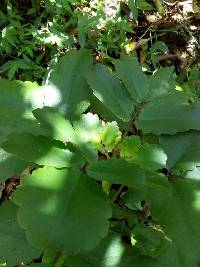
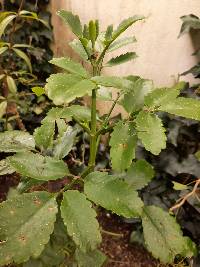
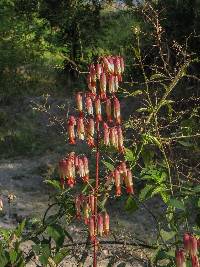
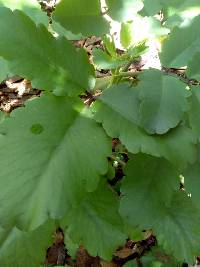
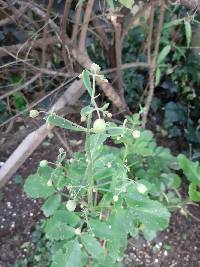
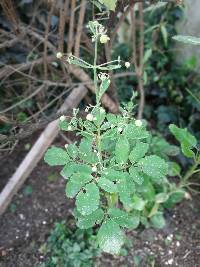
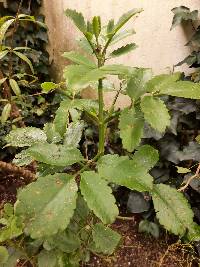
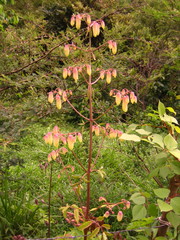
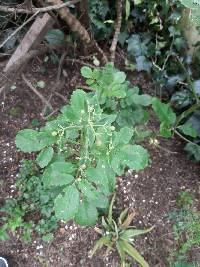
Kalanchoe pinnata, commonly known as cathedral bells, air plant, life plant, miracle leaf, and love bush, is a succulent plant native to Madagascar. It is a popular houseplant and has become naturalized in tropical and subtropical areas. The species is distinctive for the profusion of miniature plantlets that form on the margins of its leaves, a trait it has in common with some other members of Bryophyllum (now included in Kalanchoe).
Description
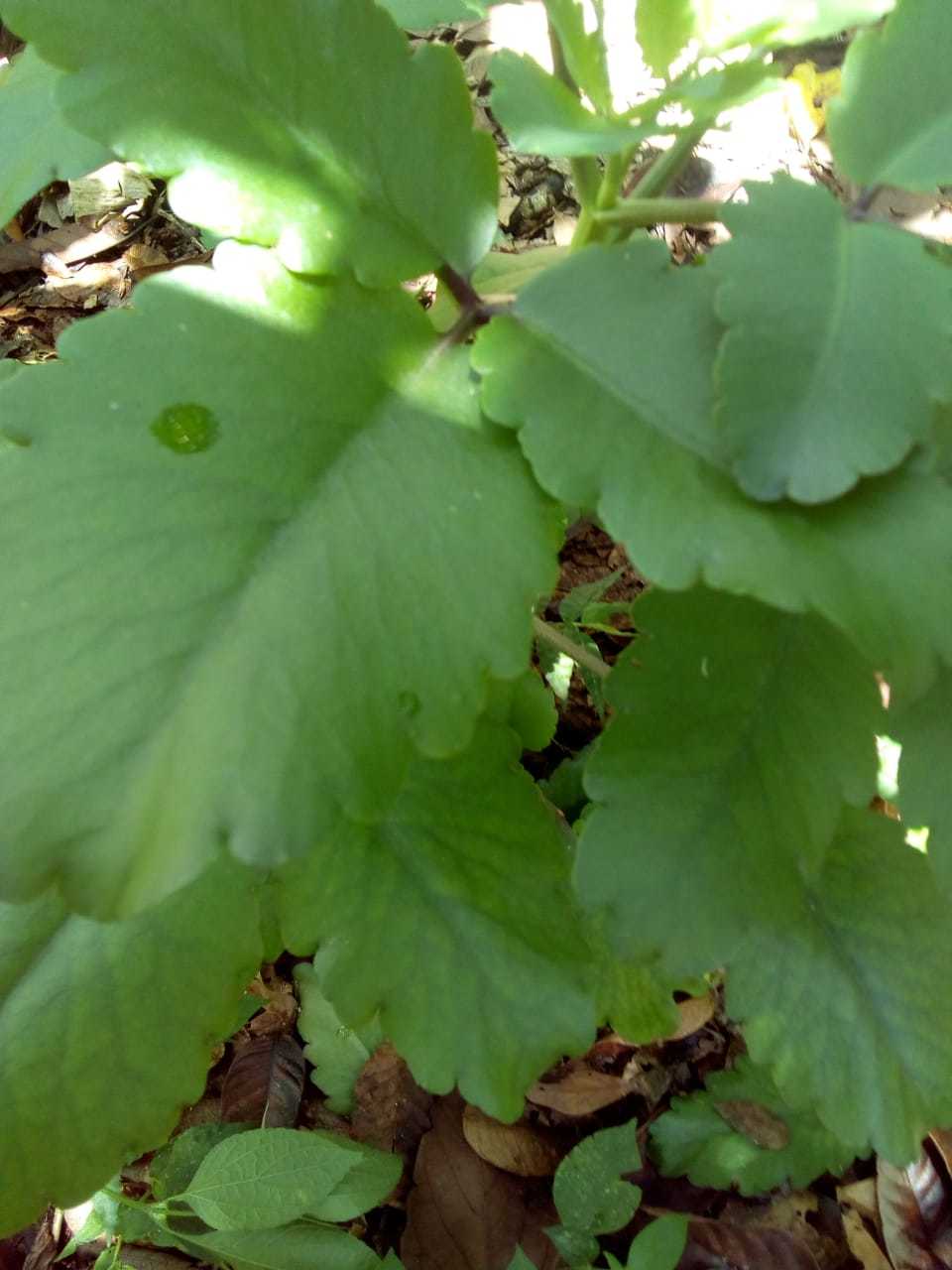
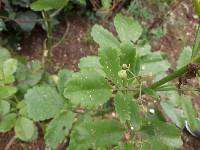
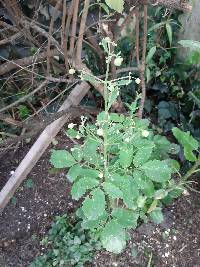
The leaves of this species are thick, fleshy, elliptical in shape, curved, with a crenate or serrated margin, often reddish. Simple at the base of the stem, the leaves are imparipinnate at the top, 10–30 cm (4–12 in) long, with three to five pairs of fleshy limb lobes.
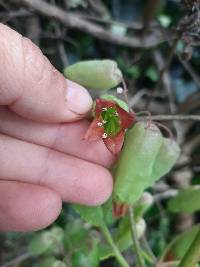
The leaves are remarkable for their ability to produce bulbils. At their margin, between the teeth, adventitious buds appear, which produce roots, stems and leaves. This is a fairly common trait in the section Bryophyllum. The fruits are follicles (10–15 mm) which are found in the persistent calyx and corolla.
The terminal inflorescence is a panicle, with many pendent, red-orange flowers. The calyx is formed of a long tube, red at the base, veined with yellowish green (or green spotted with reddish brown), with four very small triangular lobes at the end. The tubular corolla, with a pronounced constriction separating the subspherical part of the ovoid part, is terminated by four lobes which reaches 5 cm (2.0 in) in length. It is yellowish in color with red-purple streaks. The eight stamens, each about 4 cm (1.6 in) long, are in two whorls, welded on the corolla. The ovary has four carpels, slightly fused together in the center, with slender styles.
Distribution
Kalanchoe pinnata is native to Madagascar. and has become naturalized in tropical and subtropical areas, inhabiting warm and temperate climates from sea level to 2,600 m (8,500 ft), occupying sites on rock in tropical evergreen and dry deciduous...