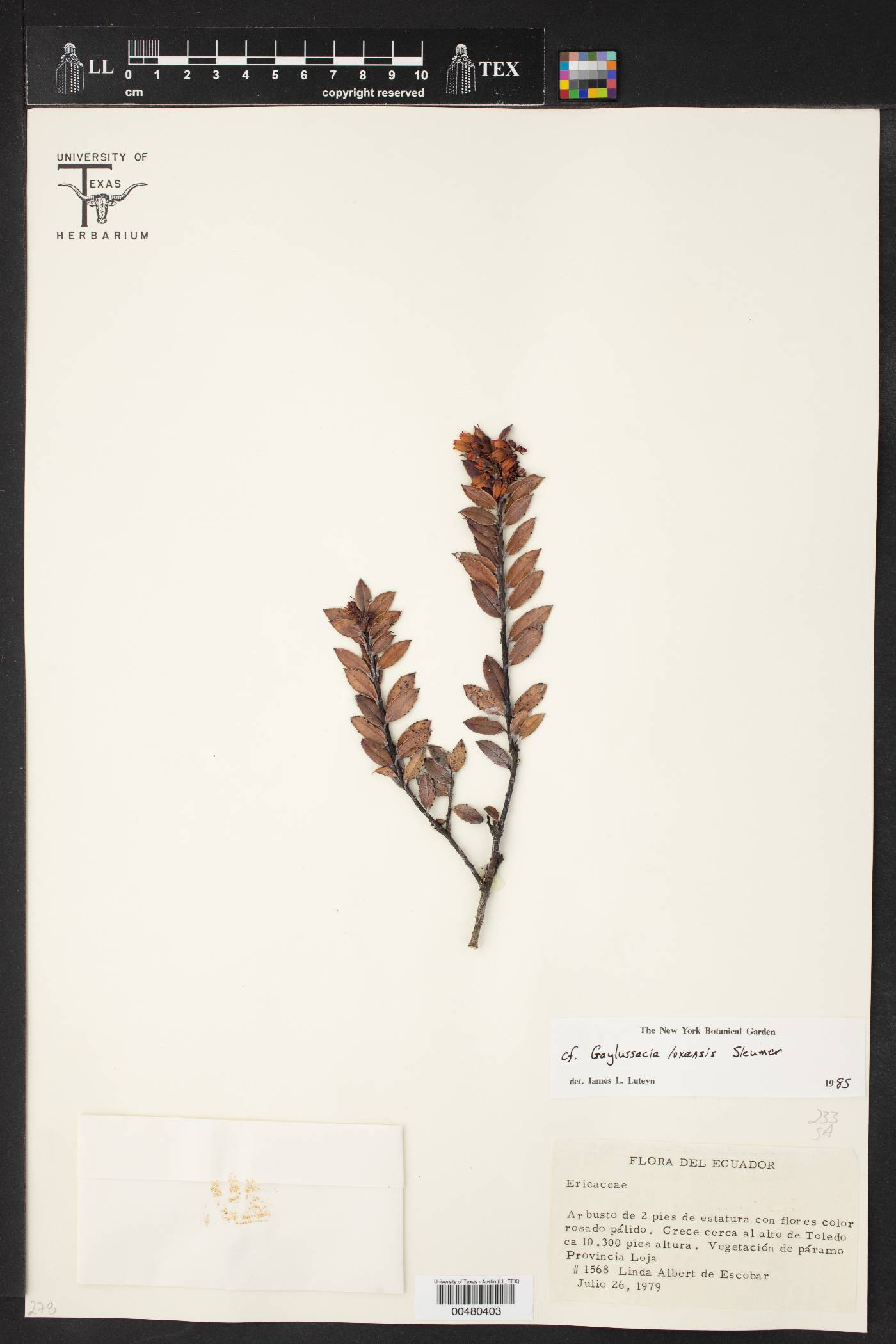
Gaylussacia is a genus of about fifty species of flowering plants in the family Ericaceae, native to the Americas, where they occur in eastern North America and in South America in the Andes and the mountains of southeastern Brazil (the majority of the known species). Common English names include huckleberry (shared with plants in several other genera) and "dangleberry".
Gaylussacia plants are often a component of an oak-heath forest. They are deciduous or evergreen shrubs growing to a height of 0.4–1.8 metres (1 ft 4 in – 5 ft 11 in).
Ecology
Gaylussacia species are used as food plants by the larvae of some Lepidoptera (butterflies and moths) species including Coleophora gaylussaciella (which feeds exclusively on Gaylussacia) and Coleophora multicristatella.
Classification
Gaylussacia is named in honor of the French chemist Joseph Louis Gay-Lussac (1778–1850). It is closely related to Vaccinium, and it is still unclear whether the commonly understood line between Vaccinium and Gaylussacia is justified. A 2002 paper found that molecular data did not support past divisions of Gaylussacia into sections.
Fossil record
Pliocene seed and fruit fossils of †Gaylussacia rhenana are described from sand-filled river-channels in the brown coal pit of Fortuna-Garsdorf near Bergheim, North Rhine-Westphalia in Germany.
Species
Gaylussacia brasiliensis
Gaylussacia amazonica – Brazil
Gaylussacia amoena – Rio de Janeiro
Gaylussacia angulata – Brazil
Gaylussacia angustifolia – Southern Brazil
Gaylussacia baccata – Black huckleberry, Southeastern Canada, eastern United States
Gaylussacia bigeloviana - East Coast of USA + Canada
Gaylussacia brachycera – Box huckleberry, Eastern United States
Gaylussacia brasiliensis – Southeastern Brazil, Paraguay
Gaylussacia buxifolia – Uva de páramo, Colombia, Venezuela
Gaylussacia caparoensis – Espírito Santo
Gaylussacia caratuvensis - Paraná
Gaylussacia cardenasii – Bolivia, Argentina
Gaylussacia centunculifolia – Minas Gerais...