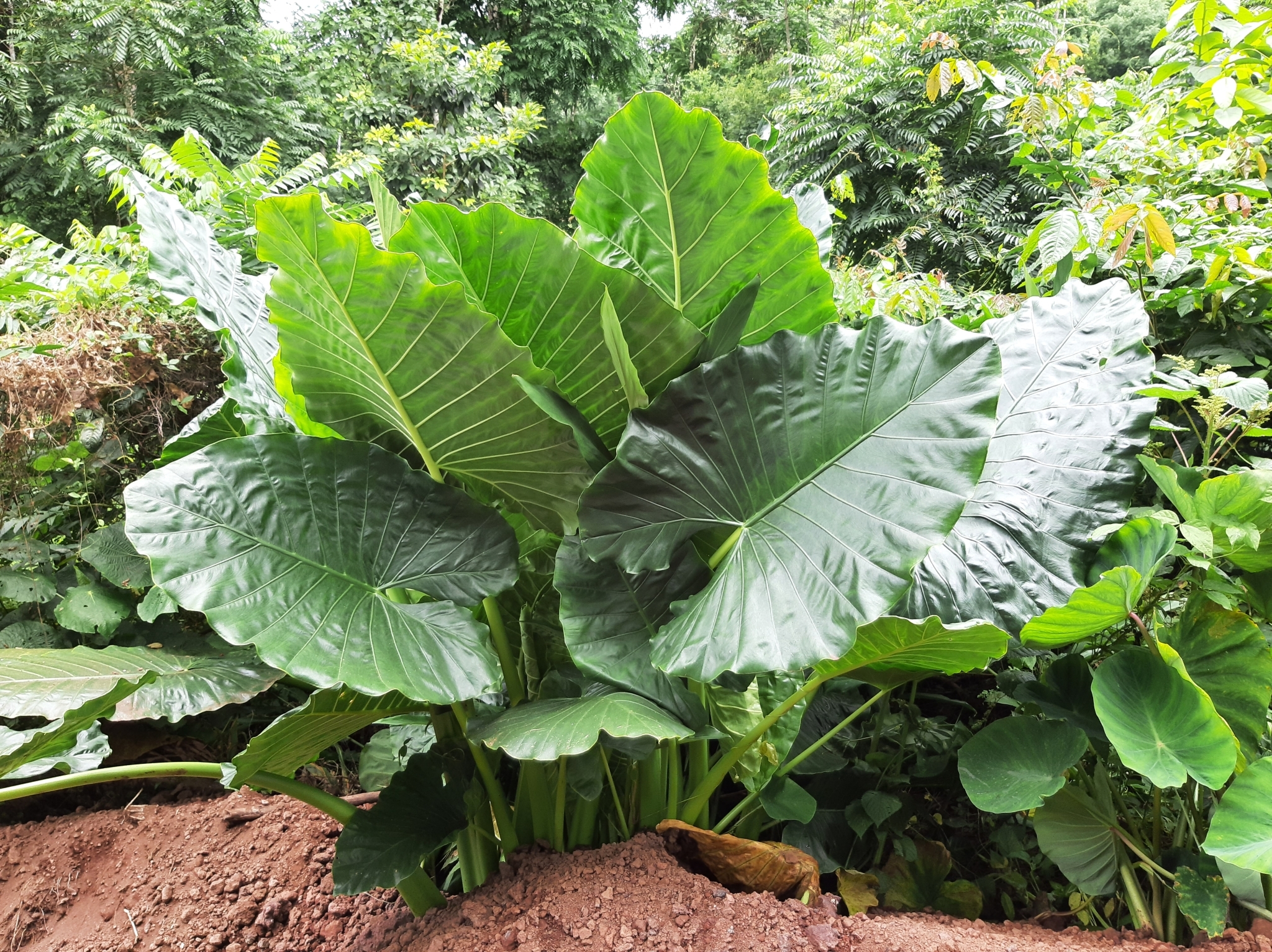
Alocasia is a genus of rhizomatous or tuberous, broad-leaved, perennial, flowering plants from the family Araceae. There are about 90 accepted species native to tropical and subtropical Asia and eastern Australia. Around the world, many growers widely cultivate a range of hybrids and cultivars as ornamentals.
Description
The large, cordate or sagittate leaves grow to a length of 20 to 90 cm (8 to 35 in) on long petioles. Their araceous flowers grow at the end of a short stalk, but are not conspicuous; often hidden behind the leaf petioles.
The corms of some species can be processed to make them edible, however, the raw plants contain raphid or raphide crystals of calcium oxalate along with other irritants (possibly including proteases) that can numb and swell the tongue and pharynx. This can cause difficulty breathing and sharp pain in the throat. Lower parts of the plant contain the highest concentrations of the poison.
Prolonged boiling before serving or processing may reduce risk of adverse reactions. Additionally, acidic fruit such as tamarind may dissolve the raphides altogether. It's important to note, however, that this genus varies in toxicity, and can still be dangerous to ingest, even after taking precautions.
Species
As of August 2026, there are 91 accepted species of Alocasia. The list below includes those accepted species with their common names (where available) and distribution ranges:
Flower
Leaf
Scientific name
Distribution
Alocasia acuminata Schott
Indonesia
Alocasia aequiloba N.E.Br.
New Guinea
Alocasia alba Schott
Sri Lanka
Alocasia arifolia Hallier f.
Malaysia
Alocasia atropurpurea Engl.
Philippines
Alocasia augustiana L.Linden & Rodigas
New Guinea
Alocasia azlanii K.M.Wong & P.C.Boyce
Brunei
Alocasia baginda Kurniawan & P.C.Boyce
Kalimantan
Alocasia balgooyi A.Hay
Sulawesi
Alocasia beccarii Engl.
Malaysia
Alocasia boa A.Hay
New Guinea