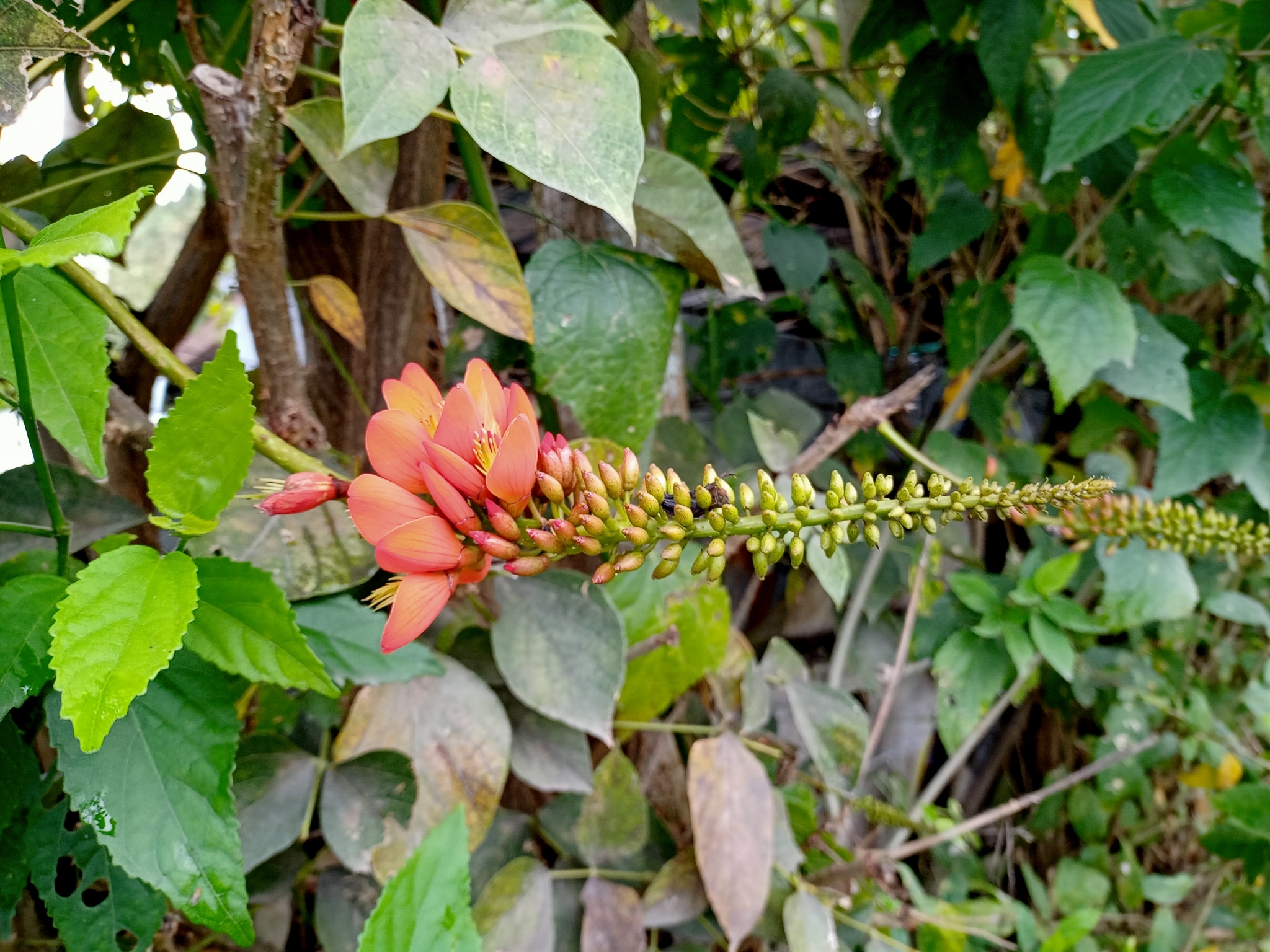
Erythrina edulis (basul) is a Andean tree species. It is nitrogen fixing and potentially useful in agroforestry, but is not commonly cultivated. It is a legume, producing protein-rich beans pods that can be used for human or animal nutrition.

Distribution and habitat
It is native to the Andean region from western Venezuela to southern Bolivia.
Cultivation
Erythrina edulis is a vigorous, fast-growing precocious legume species, and is considered one of the easiest trees to grow. As it is sensitive to the cold, it grows only in the tropics and is not suitable for temperate regions. Optimum temperatures are between 15 and 22 °C (59 and 72 °F), and it grows in a broad range of altitudes, from 900 to 3,200 m (3,000 to 10,500 ft) above sea level. In its native habitat, the average annual precipitation varies between 450 and 1,800 mm (18 and 71 in). It grows best in well-drained soils with a sandy or clayey texture and a pH ranging from 5.5 to 7.
Erythrina edulis is a totipotent plant and thus propagates easily. Hence, stems can be cut and planted into the soil and will sprout. Propagation can also be achieved by planting mature seeds and in most cases they germinate easily. Grafting is another possibility; the advantage is that seed production will start earlier. The seeds must be planted very soon after harvesting because they lose their viability 8 days after harvesting. The viability can be extended to 20 days when the seeds are covered in a thin paraffin layer. Erythrina edulis produces a raceme of red flowers, which are pollinated by bees, wasps and birds. The ripening of the seeds is not synchronized.
The tree can live for decades and the older it gets, the more grain it will produce. A three- to four-year-old tree can produce about 30 kg (66 lb) of grain per year, while a 20-year-old tree reaches 120 to 210 kg (260 to 460 lb) of grain per year. Thanks to the symbiosis with Rhizobium bacteria, E. edulis can fix atmospheric...