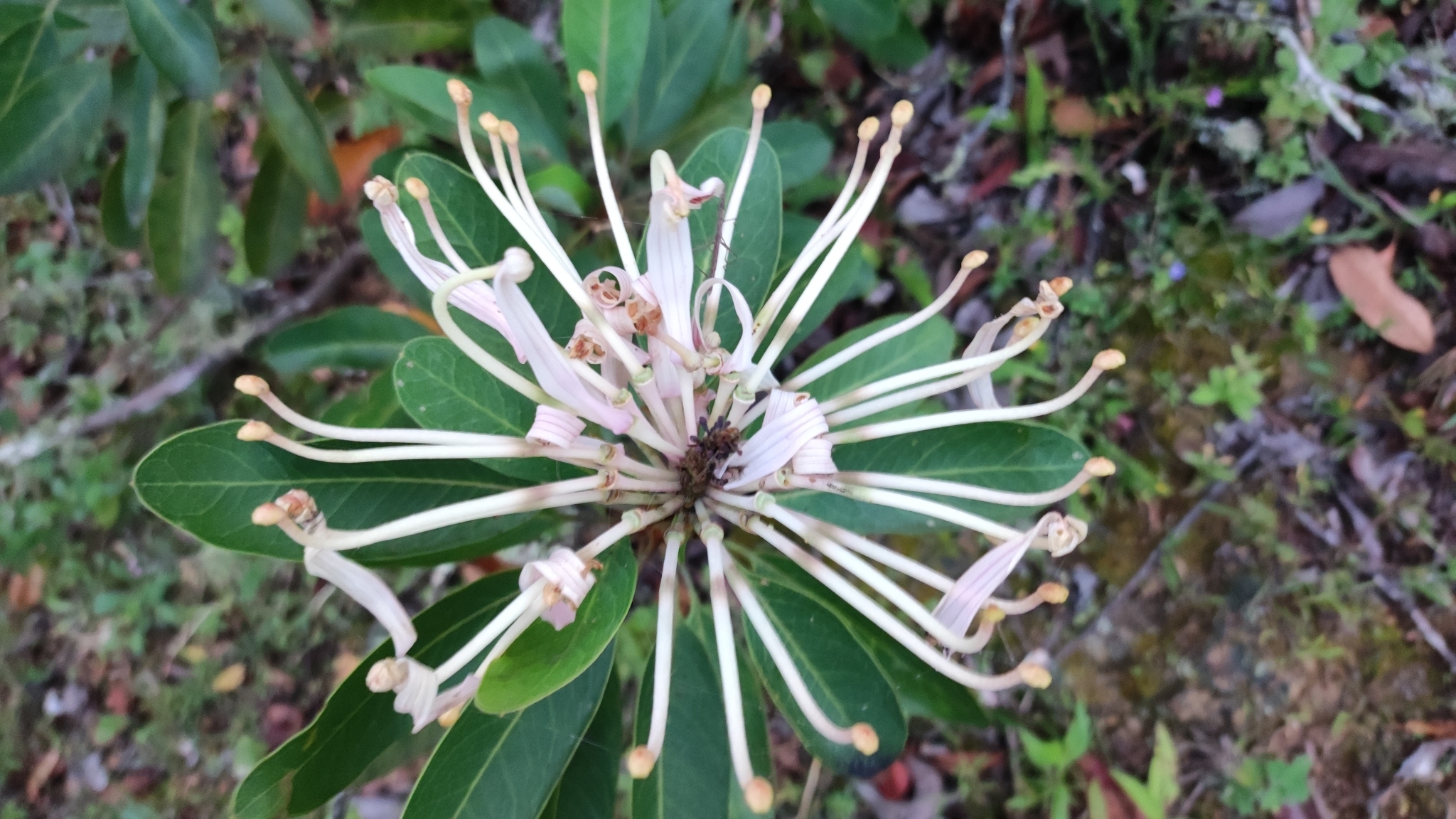
The Proteaceae form a family of flowering plants predominantly distributed in the Southern Hemisphere. The family comprises 83 genera with about 1,660 known species. Australia and South Africa have the greatest concentrations of diversity. Together with the Platanaceae (plane trees), Nelumbonaceae (the sacred lotus) and in the recent APG IV system the Sabiaceae, they make up the order Proteales. Well-known Proteaceae genera include Protea, Banksia, Embothrium, Grevillea, Hakea, and Macadamia. Species such as the New South Wales waratah (Telopea speciosissima), king protea (Protea cynaroides), and various species of Banksia, Grevillea, and Leucadendron are popular cut flowers. The nuts of Macadamia integrifolia are widely grown commercially and consumed, as are those of Gevuina avellana on a smaller scale.
Etymology
The name Proteaceae was adapted by Robert Brown from the name Proteae coined in 1789 for the family by Antoine Laurent de Jussieu, based on the genus Protea, which in 1767, Carl Linnaeus derived from the name of the Greek god Proteus, a deity who was able to change between many forms.
Taxonomy
Isopogon anemonifolius
First described by French botanist Antoine Laurent de Jussieu, the family Proteaceae is a fairly large one, with around 80 genera, but less than 2,000 species. It is recognised by virtually all taxonomists. Firmly established under classical Linnaean taxonomy, it is also recognised by the cladistics-based APG and APG II systems. It is placed in the order Proteales, whose placement has itself varied.
A classification of the genera within Proteaceae was made by Lawrie Johnson and Barbara Briggs in their influential 1975 monograph "On the Proteaceae: the evolution and classification of a southern family", until it was largely superseded by the molecular studies of Peter H. Weston and Nigel Barker in 2006. Proteaceae are now divided into five subfamilies: Bellendenoideae, Persoonioideae, Symphionematoideae, Proteoideae and Grevilleoideae. In 2008...