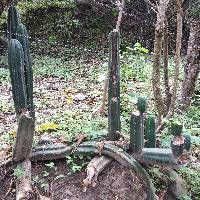
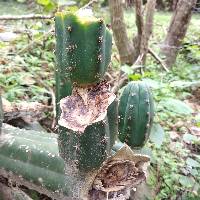
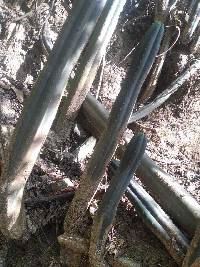
Echinopsis pachanoi, synonyms including Trichocereus pachanoi and Trichocereus macrogonus var. pachanoi, is a fast-growing columnar cactus found in the Andes at 2,000–3,000 m (6,600–9,800 ft) in altitude. It is one of a number of kinds of cacti known as San Pedro cactus. It is native to Ecuador, and Peru, but is also found in Bolivia, Colombia, central Chile, the Canary Islands, and mainland Spain, and is cultivated in other parts of the world. Uses for it include traditional medicine and traditional veterinary medicine, and it is widely grown as an ornamental cactus. It has been used for healing and religious divination in the Andes Mountains region for over 3,000 years.
Description
Echinopsis pachanoi has light to dark green stems, sometimes glaucous, with a diameter of 6–15 cm (2.4–5.9 in) and usually 6–8 ribs. The whitish areoles may produce up to seven yellow to brown spines, each up to 2 cm (0.8 in) long although typically shorter in cultivated varieties, sometimes being mostly spineless. The areoles are spaced evenly along the ribs, approximately 2 cm (0.8 in) apart. Its relatively sparse spination is one reason it is widely cultivated as an ornamental and landscaping plant. E. pachanoi is normally 3–6 m (10–20 ft) tall and has multiple branches, usually extending from the base but will emerge around broken branches. The tallest recorded specimen was 12.2 metres (40 ft) tall. White flowers are produced at the end of the stems; they open at night and last for about two days. Large numbers can be produced by well established cacti and may open new flowers over a period of weeks. The flowers are large, around 19–24 cm (7.5–9.4 in) long with a diameter of up to 20 cm (7.9 in) and are highly fragrant. There are black hairs along the length of the thick base leading to the flower. Oblong dark green fruits are produced after fertilization, about 3 cm (1.2 in) across and...