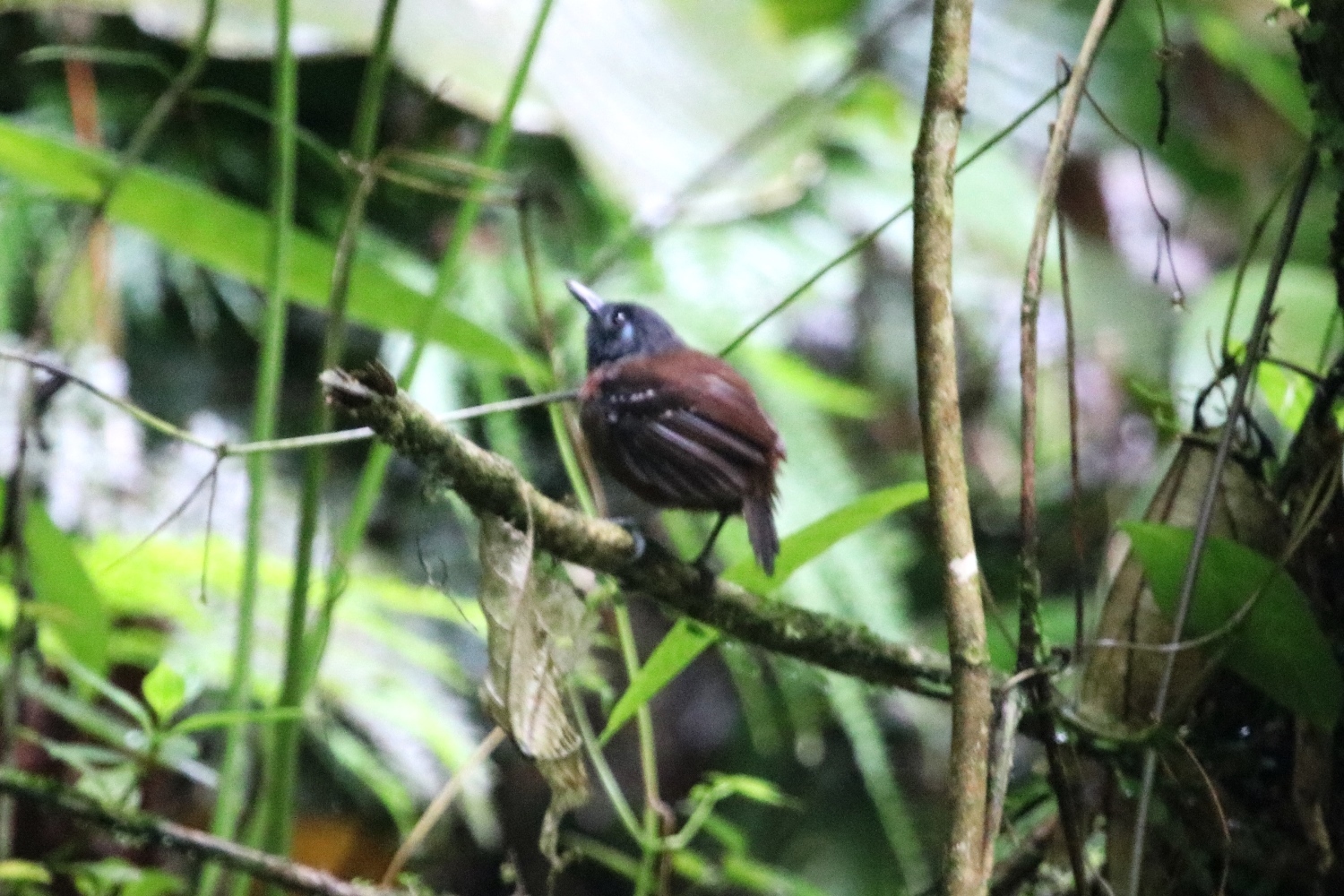
The chestnut-backed antbird (Poliocrania exsul) is a passerine bird in subfamily Thamnophilinae of family Thamnophilidae, the "typical antbirds". It is found in Colombia, Costa Rica, Ecuador, Honduras, Nicaragua, and Panama.
Taxonomy and systematics
The chestnut-backed antbird was described by the English zoologist Philip Sclater in 1859 and given the binomial name Myrmeciza exsul. A molecular phylogenetic study published in 2013 found that the genus Myrmeciza, as then defined, was polyphyletic. In the resulting rearrangement to create monophyletic genera, the chestnut-backed antbird was moved to a newly erected genus Poliocrania. The name of the new genus combines the Ancient Greek words polios "ash-gray" and kranion "head" or "skull". The chestnut-backed antbird is the only member of genus Poliocrania.
The International Ornithological Congress, the Clements taxonomy, and both the North and South American Classification Committees of the American Ornithological Society assign these five subspecies to the chestnut-backed antbird:
P. e. exsul (Sclater, PL, 1859)
P. e. occidentalis (Cherrie, 1891)
P. e. cassini (Ridgway, 1908)
P. e. niglarus (Wetmore, 1962)
P. e. maculifer (Hellmayr, 1906)
However, BirdLife International's Handbook of the Birds of the World (HBW) treats P. e. cassini and P. e. maculifer as a separate species, the short-tailed antbird Poliocrania maculifer, and retains the English name chestnut-backed antbird for the other three subspecies.
This article follows the one-species, five-subspecies model.
Female M. e. occidentalis in Corcovado National Park, Costa Rica
Description
The chestnut-backed antbird is 14 to 15 centimetres (5.5 to 5.9 in) long and weighs about 29 grams (1.0 oz). Both sexes of all subspecies have a pale blue patch of bare skin around each eye. Adult males of the nominate subspecies P. e. exsul have a slate-black head and neck. Their upperparts are deep chestnut. Their wings and tail are deep chestnut with some black and white...