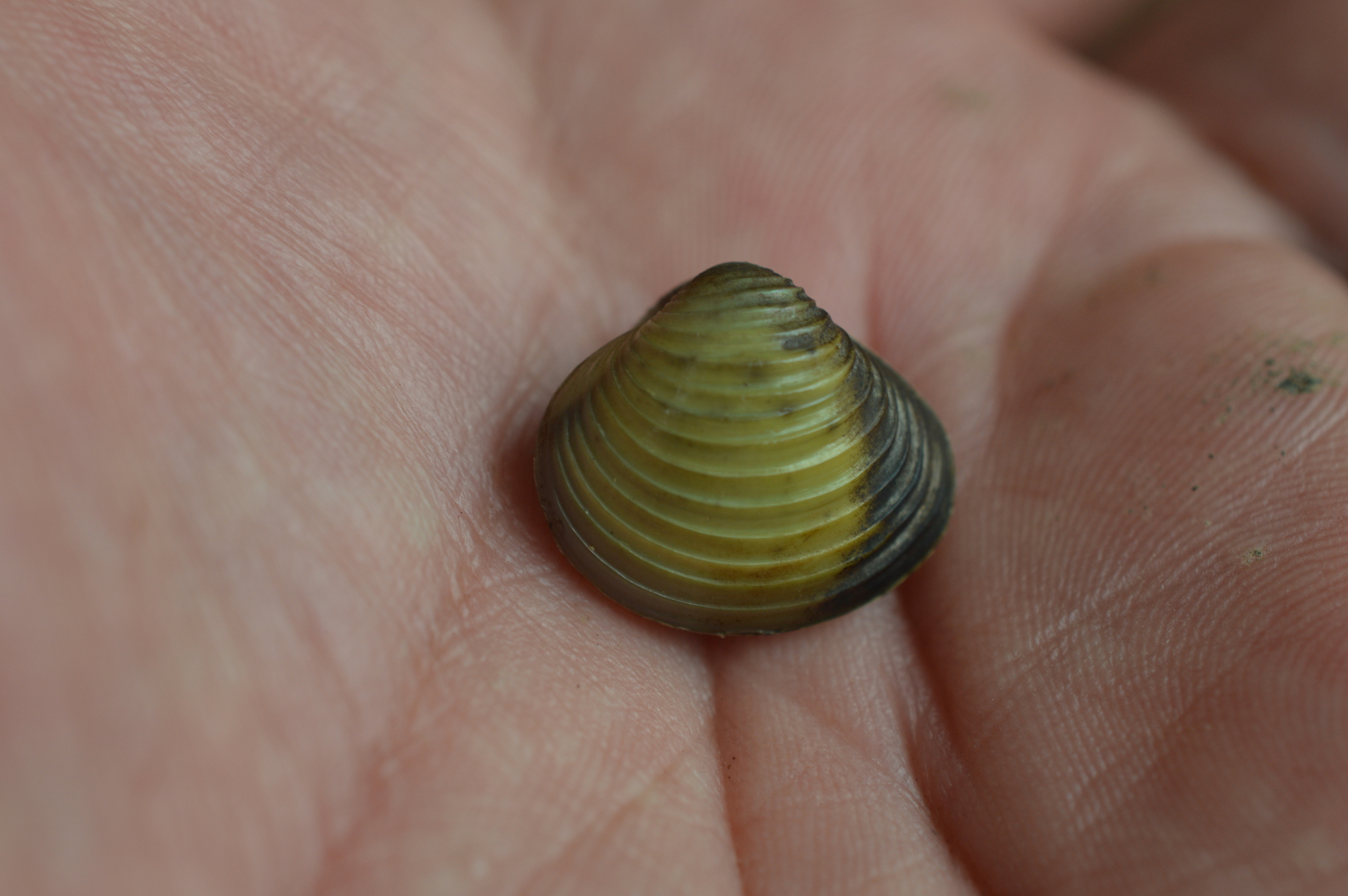
Corbicula fluminea is a species of freshwater clam native to eastern Asia which has become a successful invasive species throughout the world, including North America, South America, Europe, and New Zealand. It is native to freshwater environments of Eastern Asia, including Russia, Thailand, Cambodia, the Philippines, China, Taiwan, Korea, and Japan. C. fluminea also occurs naturally in freshwater environments of Africa. Corbicula fluminea is commonly known in the west as the Asian clam, Asiatic clam, or Asian gold clam. In Southeast Asia, C. fluminea is known as the golden clam, prosperity clam, pygmy clam, or good luck clam. In New Zealand, it is commonly referred as the freshwater gold clam.
Overview
Corbicula have had global success as an aquatic invasive species, having been introduced to a novel range including South America, North America and Europe. Human industrial activity, such as transport of larvae via ballast water in container ships, has been noted in the literature as a chief invasion vector. A market exists for Asian clams for human consumption in Japan, China, and other countries in the region. According to the United States Geological Survey, C. fluminea is likely to continue to expand its North American range until it reaches the maximum extent of its low temperature tolerance. The periostracum of the shell is normally yellow-green, brown, or black with concentric growth rings of the prismatic layer visible through the proteinous outer layer. The periostracum can flake, allowing the white prismatic layer to show through. The shells exhibit a light purple nacre on the inside.
As a filter feeder, Corbicula strains suspended contents of nearby water and absorbing material to feed itself. Large quantities of toxins are absorbed in their gut, accumulating high concentrations of toxins. The clams excrete large quantities of inorganic chemicals, such as nitrogen and phosphorus, after feeding off sediment. Despite edibility of Corbicula in native...