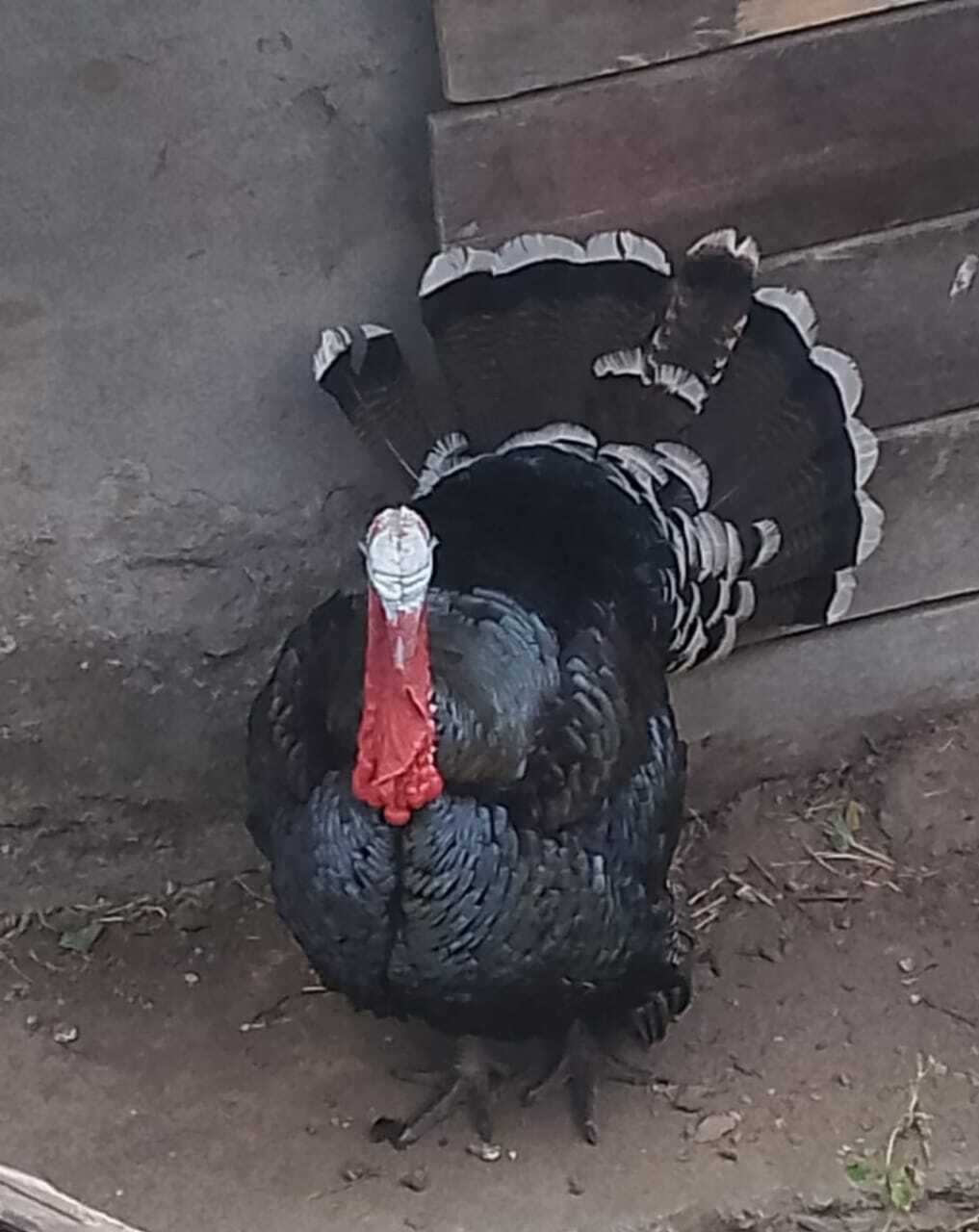
The wild turkey (Meleagris gallopavo) is an upland game bird native to North America, one of two extant species of turkey and the heaviest member of the order Galliformes. It is the ancestor to the domestic turkey (M. g. domesticus), which was originally derived from a southern Mexican subspecies of wild turkey (not the related ocellated turkey).
Taxonomy
The wild turkey was formally described in 1758 by the Swedish naturalist Carl Linnaeus in the tenth edition of his Systema Naturae under its current binomial name Meleagris gallopavo. The type locality is Mexico. The genus name Meleagris is from Ancient Greek μελεαγρις/meleagris meaning "guineafowl". The specific epithet gallopavo is a late Medieval Latin word for a wild turkey: it combines Latin gallus meaning "fowl" and pavo meaning "peacock". The word was used in 1555 by the Swiss naturalist Conrad Gessner in his Historiae animalium.
Six subspecies are recognised:
Subspecies
Common name
Distribution
Meleagris gallopavo gallopavo
Linnaeus, 1758
South Mexican wild turkey
south Mexico
Meleagris gallopavo intermedia
Sennett, 1879
Rio Grande wild turkey
north Texas to central east Mexico
Meleagris gallopavo merriami
Nelson, 1900
Merriam's wild turkey
west USA
Meleagris gallopavo mexicana
Gould, 1856
Gould's wild turkey
northwest, central north Mexico (includes onusta)
Meleagris gallopavo osceola