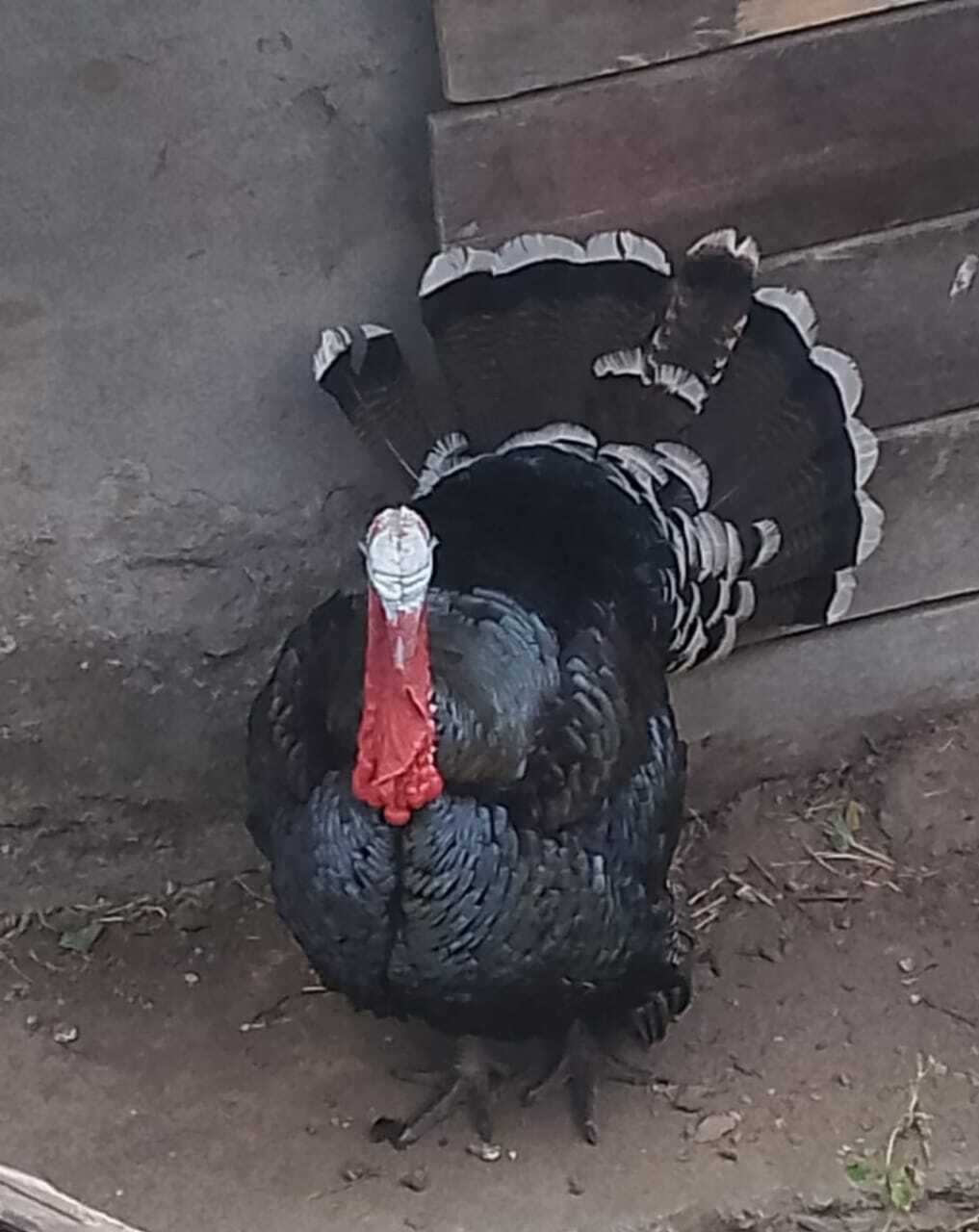
Turkeys are large, heavyset galliforms in the genus Meleagris, indigenous to the Americas. They are among the largest birds in their native ranges, as well as being one of the heaviest birds in the order Galliformes. There are two extant turkey species: the wild turkey (Meleagris gallopavo) of Southern, Central and Eastern North America, and the ocellated turkey (Meleagris ocellata) of the Yucatán Peninsula in Mexico. Males of both species have a distinctive singular fleshy wattle, called a snood, that hangs from the base of the culmen. Like with other phasianines, the male is bigger and sports fancier plumage than the female.
The earliest turkeys evolved in North America over 20 million years ago. They share a recent common ancestor with grouse, pheasants, and other fowl. The North American wild turkey is the ancestor of the domestic turkey, which was domesticated approximately 2,000 years ago by indigenous peoples. It was this domestic descendant that was later transported by humans to Eurasia, during the Columbian exchange.
Name
Plate 1 of The Birds of America by John James Audubon, depicting a wild turkey
The name turkey originated as a shortening of turkey cock and turkey hen and initially denoted the guineafowl, an African bird to which the turkeys of North America are only distantly related. Guineafowl were first imported to Europe via Turkey, hence the name. Following the establishment of English colonies in the New World, the name was transferred to the superficially similar North American bird.
In languages such as French, the bird was named after India. The bird was originally called poule d'inde or chicken of India later becoming dinde.
In languages in Northern Europe such as Norwegian, Swedish, and Estonian, the bird was named after Calicut, India (now Kozhikode, India).
In 1550, the English navigator William Strickland, who had introduced the turkey into England, was granted a coat of arms including a "turkey-cock in his pride...