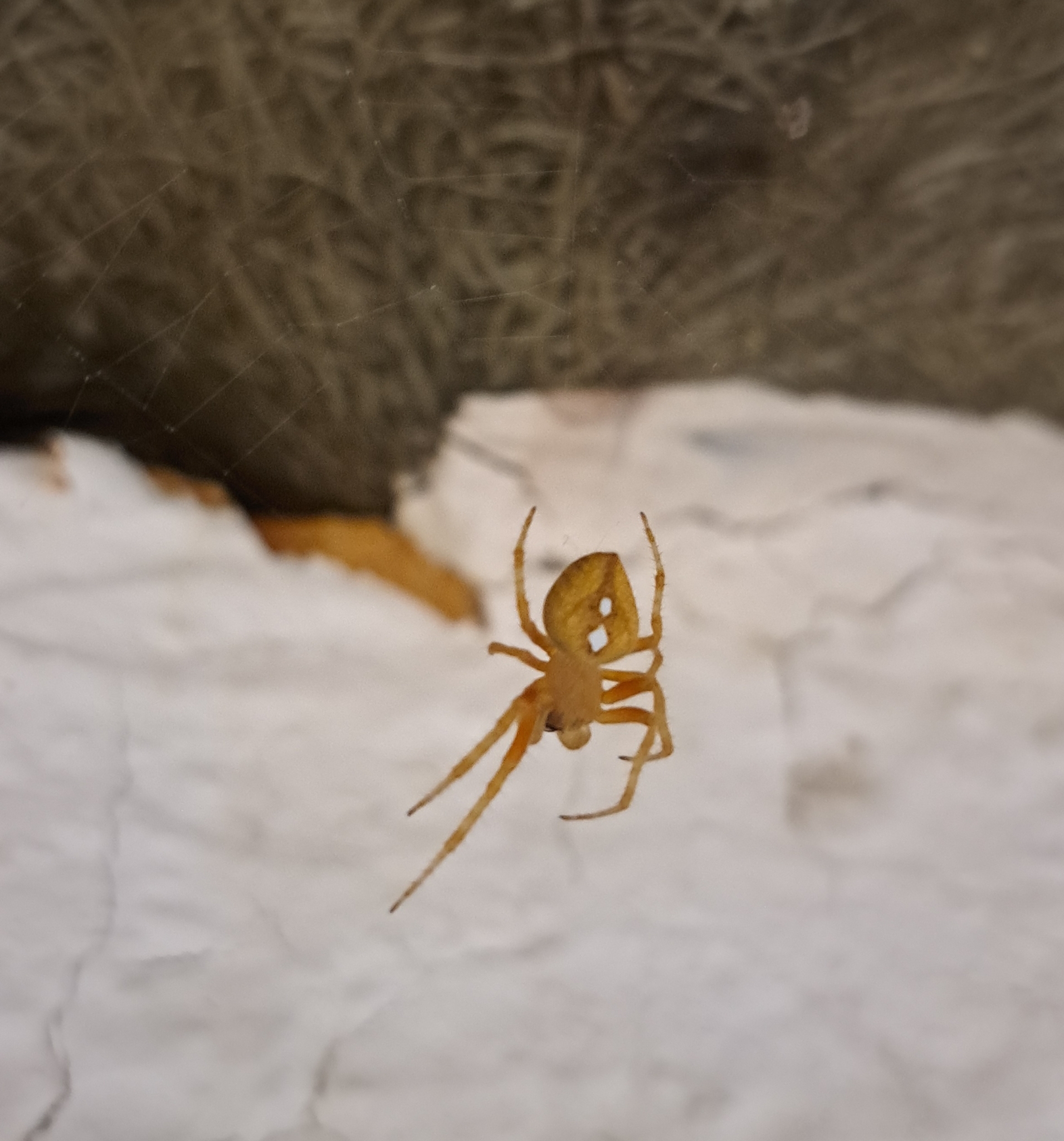
Eriophora is a genus of orb-weaver spiders first described by Eugène Simon in 1895. These spiders are found in tropical climates in the Americas, Africa, and Asia. The name is derived from Ancient Greek roots and means "wool bearing".
Description
As is common in orb-weaving spiders, species in the Eriophora genus feature a third claw used to weave their webs. While most tend to spin a balanced and symmetrical web of small to medium size, E. fuliginea has been seen to craft a large, asymmetrical web that may be 1.6 - 3m in diameter with an open "hub" in the top third of the web.
Females are typically larger than males, and have a very long epigyne scape. Males in the genus generally have an enlarged tibia of the second leg.
These spiders feature a variety of colors and patterns, the most notable being the bright green abdomens that are sometimes present in E. nephiloides and, less frequently, E. ravilla. The abdominal dorsum may have a pattern of white spots or stripes. More typical, however, is a reddish-brown to gray coloration.
Spiders in Space
Eriophora transmarina (now H. transmarina) was the second species of spider to enter orbit and successfully spin a web in space, and the first to be documented throughout the process. Their opportunity to make history was organized by a team of NASA scientists and students from Glen Waverly Secondary College in Melbourne, Australia.
The students and scientists worked together over two and a half years to develop an experiment to observe how (or if) the spidernauts would successfully adapt to and build webs in microgravity—and their careful, dedicated work came to fruition on January 16, 2003, when a team of eight spidernauts entered orbit aboard the Space Shuttle Columbia on her 28th mission. The spiders were supported by a ground-based control team, with lead spidernaut Cadbury at the helm.
The Spiders in Space project considered many species during the planning phase, but settled on Eriophora transmarina (now...