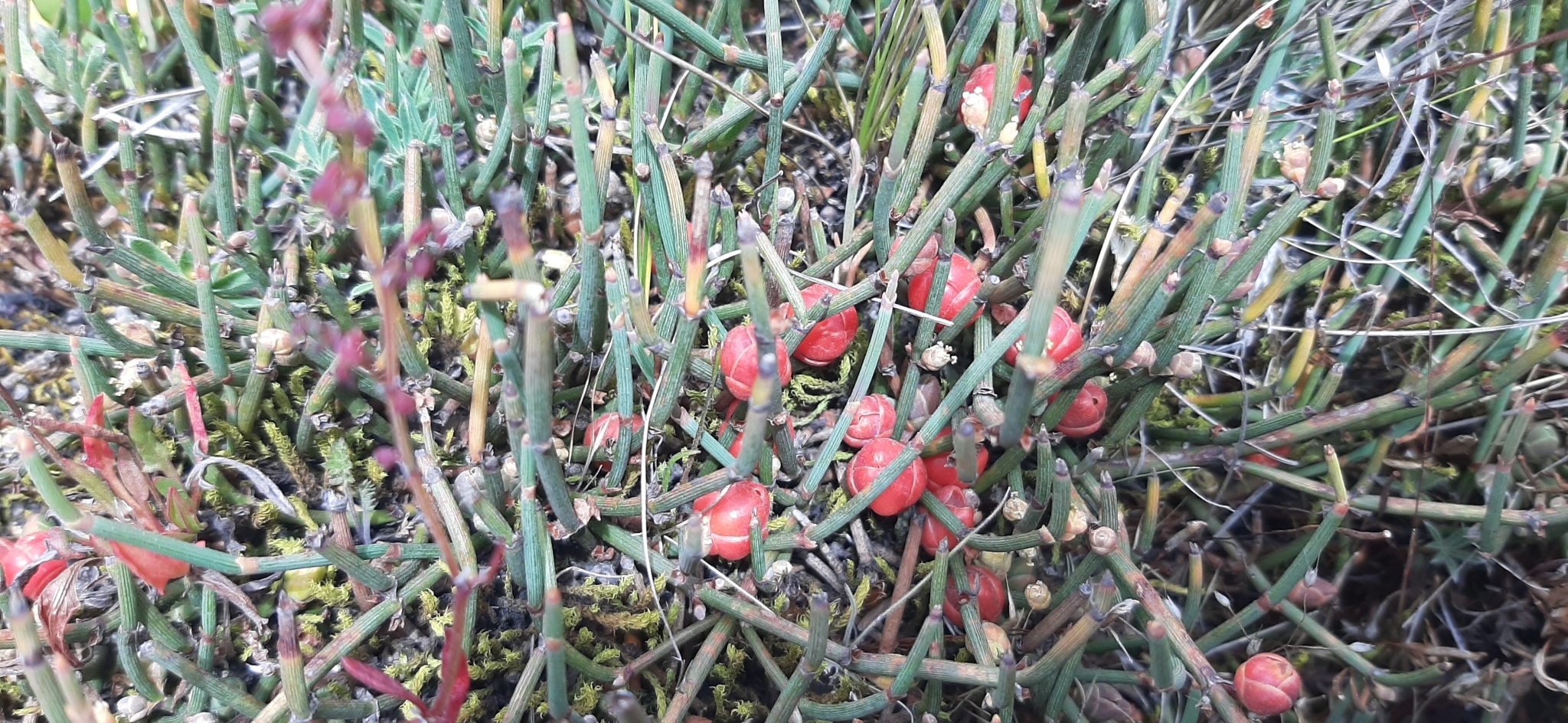
Ephedraceae is a family of gymnosperms belonging to Gnetidae, it contains only a single extant genus, Ephedra, as well as a number of extinct genera from the Early Cretaceous.
Taxonomy
Fossil Ephedraceae
Eamesia, showing male cone (B)
Chengia, showing female reproductive spike (B)
Jianchangia, showing chlamydosperms (C) and ovulate cone (F)
Diagram of Arlenea, showing closeup of terminal region with female reproductive structures (B) and cross section of a female reproductive structure.(C)
Ephedraceae is agreed to be the most basal group amongst extant gnetophytes. Members of the family typically grow as shrubs and have small, linear leaves that possess parallel veins. The fossil Ephedraceae genera show a range of morphologies transitional between the ancestral lax male and female reproductive structures and the highly compact reproductive structures typical of modern Ephedra. Modern members of Ephedra have either dry winged membranous bracts (modified leaves which surround the seed), which are dispersed by wind, leathery covered seeds, which are dispersed by seed-eating rodents, or fleshy bracts which are consumed and then dispersed by birds. Some extinct members of Ephedra from the Early Cretaceous, such as Ephedra carnosa, as well as Arlenea from the Early Cretaceous of Brazil have fleshy bracts surrounding the seeds, suggesting that these seeds were dispersed by animals.
Ephedra L. Early Cretaceous-Recent
Arlenea Ribeiro, Yang, Saraiva, Bantim, Calixto Junior et Lima, 2023 Crato Formation, Brazil, Early Cretaceous (Aptian)
Leongathia V.A. Krassilov, D.L. Dilcher & J.G. Douglas 1998 Koonwarra fossil bed, Australia, Early Cretaceous (Aptian)
Jianchangia Yang, Wang and Ferguson, 2020 Jiufotang Formation, China, Early Cretaceous (Aptian)
Eamesia Yang, Lin and Ferguson, 2018 Yixian Formation, China, Early Cretaceous (Aptian)
Prognetella Krassilov et Bugdaeva, 1999 Yixian Formation, China, Early Cretaceous...