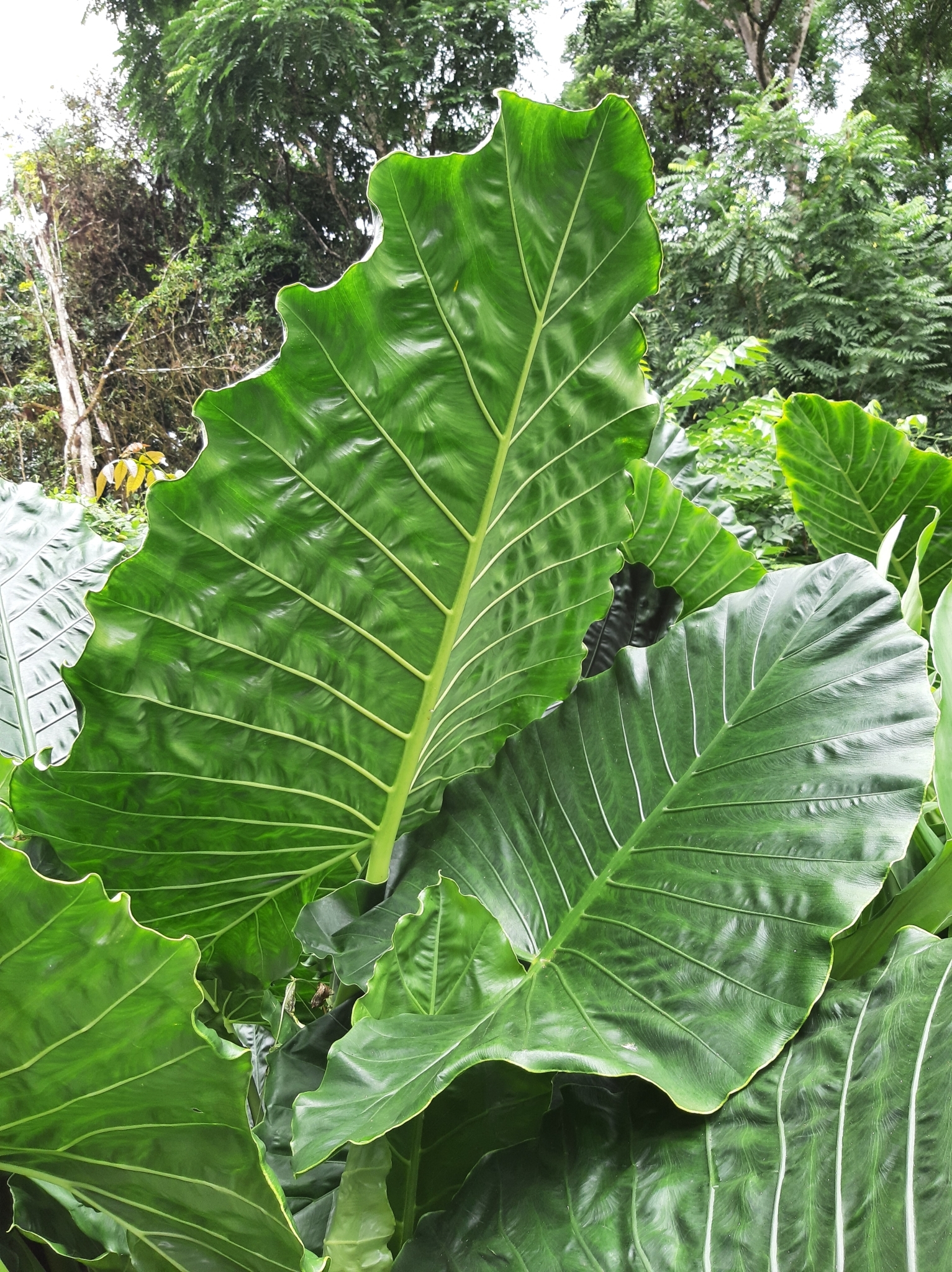
Alocasia macrorrhizos is a species of flowering plant in the arum family (Araceae) that is native to rainforests of Maritime Southeast Asia, New Guinea, and the Murray Islands group in the Torres Strait of Australia. It has long been cultivated in South Asia, the Philippines, many Pacific islands, and elsewhere in the tropics, in the order of tens of thousands of years. Common names include giant taro, giant alocasia, ʻape, biga, and pia. In Australia it is known as the cunjevoi (a term which also refers to a marine animal).
History
Giant taro in Jinguashi, Taiwan
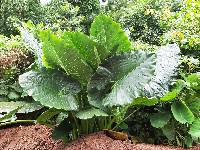
Giant taro in southern Brazil
The giant taro was originally domesticated in the Philippines, but are known from wild specimens to early Austronesians in Taiwan. From the Philippines, they spread outwards to the rest of Maritime Southeast Asia and eastward to Oceania where it became one of the staple crops of Pacific Islanders. They are one of the four main species of aroids (taros) cultivated by Austronesians primarily as a source of starch, the others being Amorphophallus paeoniifolius, Colocasia esculenta, and Cyrtosperma merkusii, each with multiple cultivated varieties. Their leaves and stems are also edible if cooked thoroughly, though this is rarely done for giant taro as it contains higher amounts of raphides which cause itching.
The reconstructed word for giant taro in Proto-Austronesian is *biRaq, which became Proto-Oceanic *piRaq. Modern cognates in Maritime Southeast Asia and Micronesia include Rukai vi'a or bi'a; Ifugao bila; Ilocano, Cebuano, and Bikol biga; Tiruray bira; Ngaju biha; Malagasy via; Malay and Acehnese birah; Mongondow biga; Palauan bísə; Chamorro piga; Bima wia; Roti and Tetun fia; Asilulu hila; and Kowiai fira. In Oceania, cognates for it include Wuvulu and Aua pia; Motu and ꞋAreꞌare hira; Kilivila and Fijian via; and Hawaiian pia. Note that in some cases, the cognates have shifted to mean other types of taro.