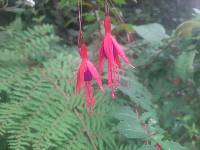
Fuchsia magellanica – commonly known as the hummingbird fuchsia, hardy fuchsia or chilco (from Mapudungun: chillko "watery") – is a species of flowering plant in the evening primrose family Onagraceae, native to the lower Southern Cone of southern South America.
Description
Fuchsia magellanica - flower
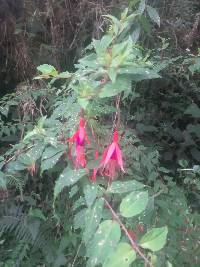
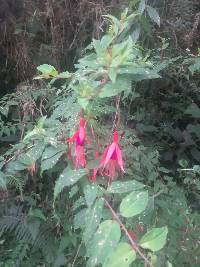
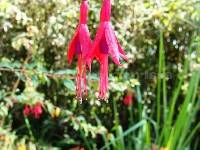
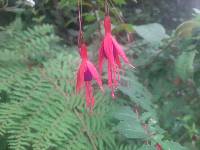
This sub-shrub with long, arcuate stems can grow to 1–3 metres (3.3–9.8 ft) in height and width in frost-free climates, and 1.2–1.5 m (4–5 ft) where colder. Its leaves grow in whorls of 3–4 per node or sometimes opposite, are ovate to lanceolate, 2.5–6 cm long, and 1–2 cm wide, with serrate margins and petioles 0.5–1 cm long. The plant blossoms profusely over a long period with many small and tubular pendent flowers, in brilliant shades of red and purple, softer shades of pink and lavender, and some in white. The perfect flowers are axillary and pendent, with peduncles 3–4.5 cm long, a magenta floral tube 10–13 mm long, magenta sepals 20–25 mm long, and dark purple petals 10–13 mm long that become convolute after anthesis. The stamens are exserted, with filaments 25–30 mm long. The berries are ellipsoid, 10–15 mm long and 0.7–0.9 mm wide. Chromosome count is 2n = 44.
F. magellanica is a consistently variable species across the whole of its natural range and, despite past usage and popular misconceptions, no scientific varieties are currently recognized by botanist Dr. Paul E. Berry, the leading authority on the genus. Care should be taken not to accord any of the many garden selections and hybrids with taxonomic status by using "var." Additionally, pollen stain tests conducted in the Pacific Northwest region of the United States by members of the Western Fuchsia Species Society have indicated that almost all of the many garden selections of this species are, in fact, hybrids to a lesser or greater degree.
It is distinguished from other species in the section by its elongated ovary and fruit, long petioles that are...