Chrysophyllum is a group of trees in the Sapotaceae described as a genus by Linnaeus in 1753.
The genus is native to the tropical Americas, from Mexico to northern Argentina, including the Caribbean. One species, C. oliviforme, extends north to southern Florida.
Description
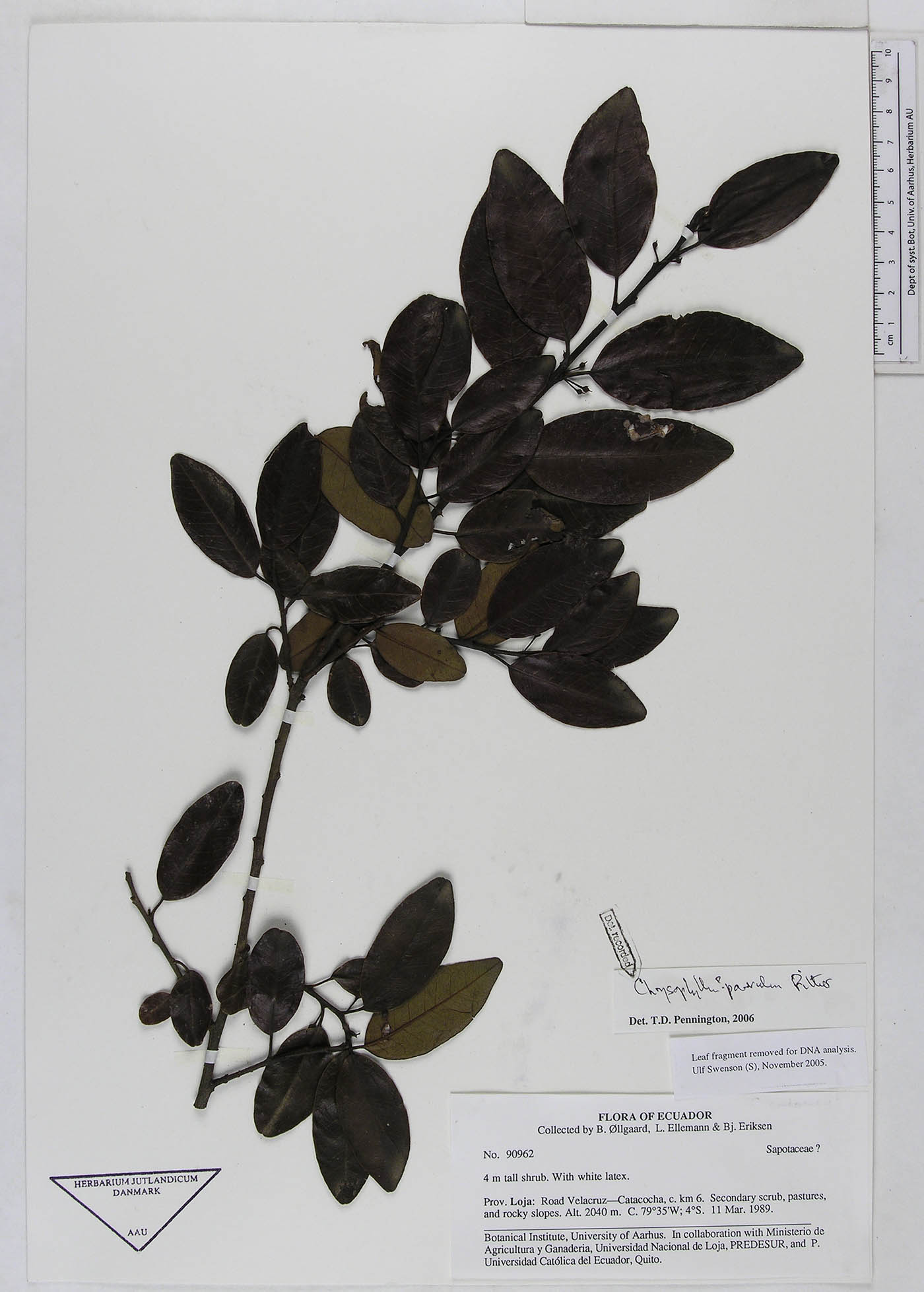
Chrysophyllum members are usually tropical trees, often growing rapidly to 10–20 m or more in height. The leaves are oval, 3–15 cm long, green above, densely golden pubescent below, from which the genus is named. The flowers are small (3–8 mm), purplish white and have a sweet fragrant smell; they are clustered several together, and are hermaphroditic (self fertile). The fruit is edible; round, usually purple skinned (sometimes greenish-white), often green around the calyx, with a star pattern in the pulp; the flattened seeds are light brown and hard. The fruit skin is chewy like gum, and contrary to some reports, is edible.
In 1990 and 1991 T.D. Pennington adopted a wide circumscription of Chrysophyllum, giving it a Pantropical distribution. Later morphological and phylogenetic studies confirmed that the genus defined by Pennington was polyphyletic, and in 2017 De Faria et al. proposed that Chrysophyllum be more narrowly circumscribed, and some species placed in the revived genera Achrouteria, Cornuella, Martiusella, Nemaluma, Prieurella, and Ragala.
Species
As of April 2025, Plants of the World Online accepts the following 37 species:
Chrysophyllum acreanum A.C.Sm. – Brazil (Acre, Amazonas)
Chrysophyllum albipilum Cronquist – Peru (San Martín)
Chrysophyllum arenarium Allemão – eastern Brazil
Chrysophyllum argenteum Jacq. – West Indies, Central America, N South America
Chrysophyllum aulacocarpum Ernst – Miranda
Chrysophyllum bicolor Poir. – Hispaniola, Puerto Rico, Virgin Islands
Chrysophyllum brenesii Cronquist – Nicaragua, Costa Rica, Panama
Chrysophyllum cainito L. – Belize, Jamaica, Cayman Is
Chrysophyllum contumacense Sagást. & M.O.Dillon –...