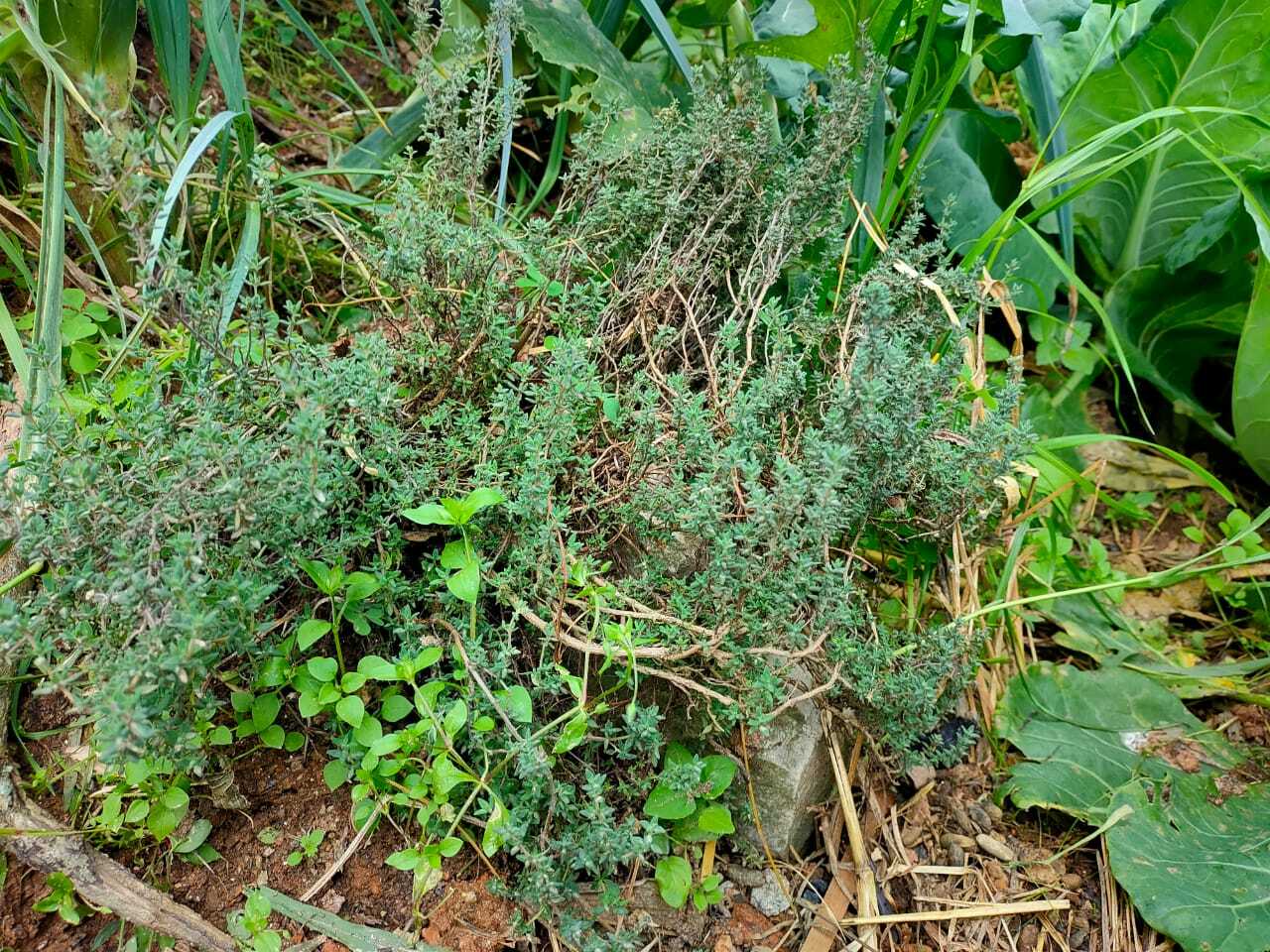
Thymus vulgaris (common thyme, German thyme, garden thyme or just thyme) is a species of flowering plant in the mint family, Lamiaceae.
Description
The plant grows to 15–30 centimetres (6–12 in) tall and 40 cm (16 in) wide, forming a woody, evergreen subshrub with small and highly aromatic grey-green leaves, as well as clusters of purple or pink flowers in early summer.
@media all and (max-width:720px){
Shoot
Specimen in bloom
Etymology
The Latin specific epithet vulgaris means 'common' in the sense of 'widespread'.
Distribution and habitat
The species is native to southern Europe from the western Mediterranean to southern Italy.
Uses
It is useful in the garden as groundcover, where it can be short-lived, but is easily propagated from cuttings. It is also the main source of the herb thyme, used as an ingredient in cooking and as a herbal medicine. It is slightly spicier than oregano and sweeter than sage.
Cultivars
Numerous cultivars and hybrids have been developed for ornamental purposes. Nomenclature can be very confusing.
French, German and English varieties vary by leaf shape and colour and essential oils.
The many cultivars include 'Argenteus' (silver thyme).
The cultivar 'Silver Queen', with white-margined leaves, has gained the Royal Horticultural Society's Award of Garden Merit.
Bibliography
L. H. Bailey; Manual of Cultivated Plants.
M. Easter; International Thymus Register and Checklist.