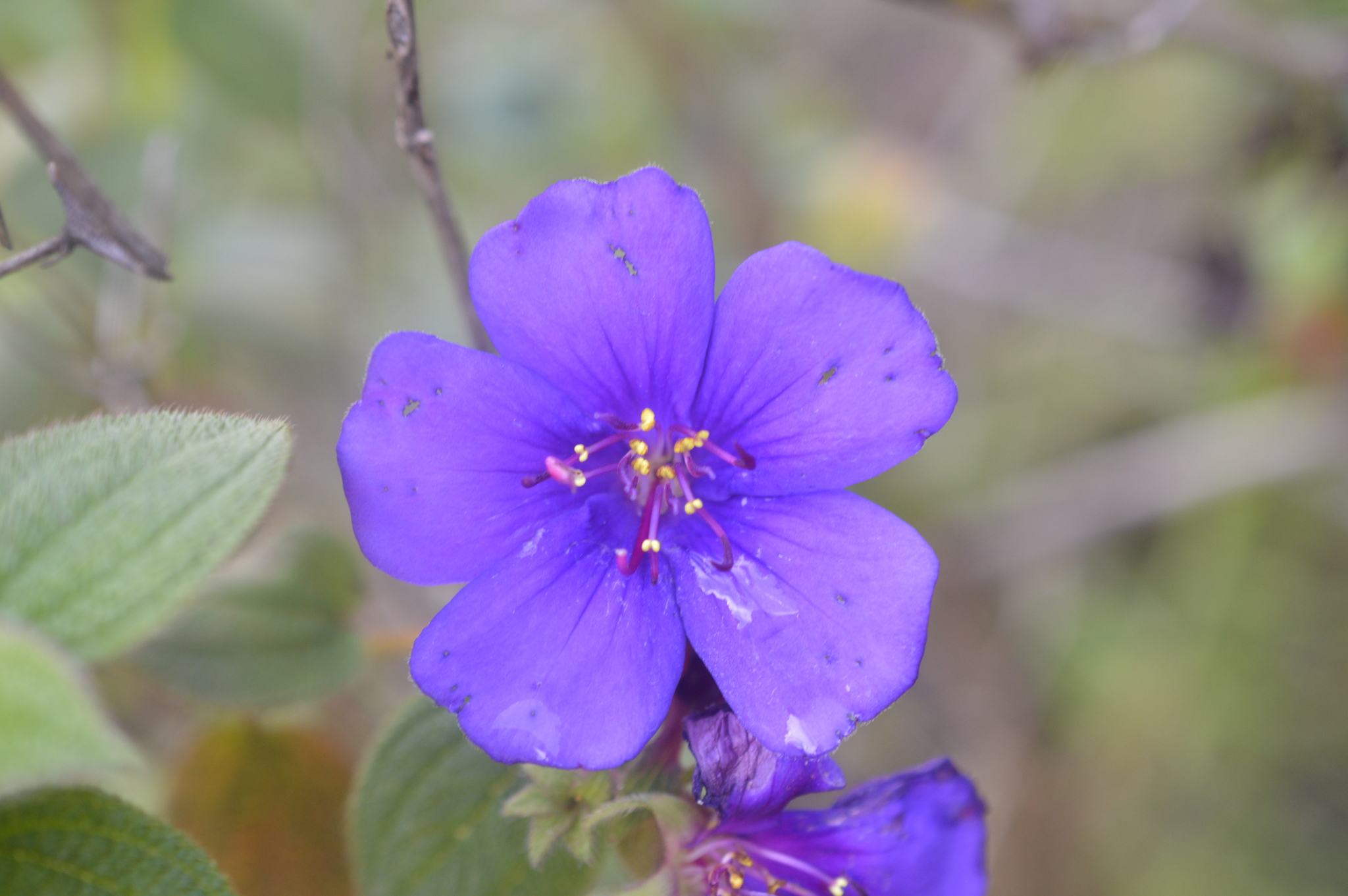
Chaetogastra is a genus of flowering plants belonging to the family Melastomataceae. Its native range is South America and North America. It contains around 115 species.
Description
Species of Chaetogastra are herbs, subshrubs, shrubs or small trees. Their leaves are opposite and have petioles. The inflorescence is a terminal panicle or some modification of one. The flowers are hypogynous, with a bell-shaped hypanthium (base of the flower), usually very hairy (pubescent) on the outside. There are four or five petals, usually dark lilac to purple, more rarely white, yellow or deep red. There are eight or ten stamens which may be all the same or in two series of different sizes. The connectives at the base of the anthers are prolonged, with two ventral lobes. The numerous seeds are borne in a dry, semiwoody capsule, and are more-or-less spiral (cochleate) in shape.
Taxonomy
The genus Chaetogastra was established by Augustin de Candolle in 1828. In 1885, in his treatment for Flora brasiliensis, Alfred Cogniaux used a broad concept of the genus Tibouchina, transferring into it species at that time placed in many other genera, including Chaetogastra. This broad concept was generally adopted subsequently, and around 470 taxa were at one time or another assigned to Tibouchina, including those placed in Chaetogastra. A phylogenetic analysis in 2013 based on molecular data (2 plastid and 1 nuclear regions) showed that the traditional circumscription of Tibouchina was paraphyletic. Four major clades were resolved within the genus, which were supported by morphological, molecular and geographic evidence. A further molecular phylogenetic study in 2019 used the same molecular markers but included more species. It reached the same conclusion: the original broadly circumscribed Tibouchina consisted of four monophyletic clades. The authors proposed a split into four genera: a more narrowly circumscribed Tibouchina, two re-established genera Pleroma and Chaetogastra, and a new genus,...