The tropical grass species Cenchrus clandestinus (previously Pennisetum clandestinum) is known by several common names, most often Kikuyu grass. It is native to the highland regions of East Africa that is home to the Kikuyu people. Because of its rapid growth and aggressive nature, it is categorised as a noxious weed in some regions. However, it is also a popular garden lawn species in Australia, New Zealand, South Africa and the southern region of California in the United States, being inexpensive and moderately drought-tolerant. In addition, it is useful as pasture for livestock grazing and serves as a food source for many avian species, including the long-tailed widowbird. The flowering culms are very short and "hidden" amongst the leaves, giving this species its specific epithet (clandestinus).
Description and habitat
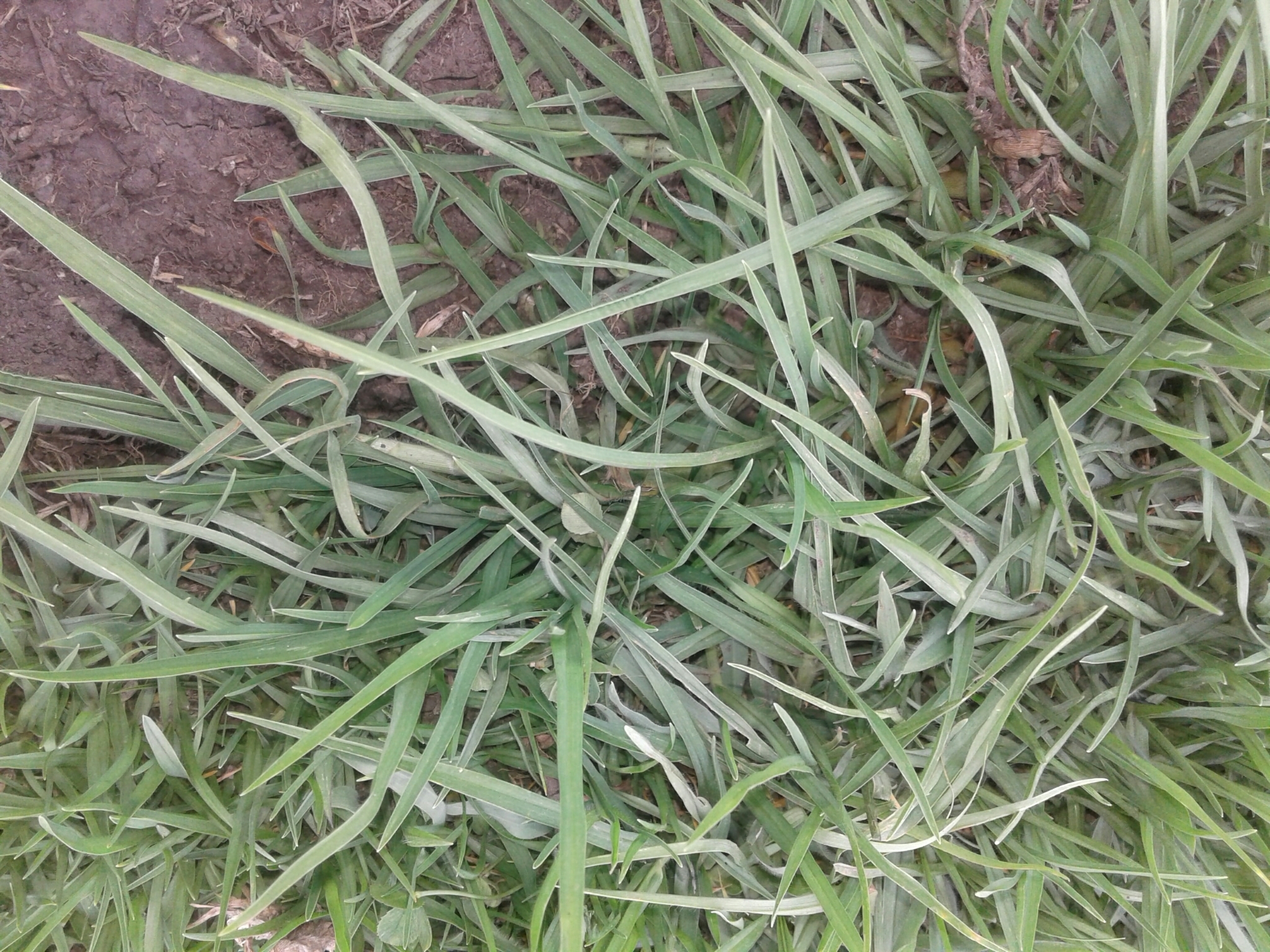
Cenchrus clandestinus is a rhizomatous grass with matted roots and a grass-like or herbaceous habit. The leaves are green, flattened or upwardly folded along the midrib, 10–150 mm (0.39–5.91 in) long, and 1–5 mm (0.039–0.197 in) wide. The apex of the leaf blade is obtuse.
It occurs in sandy soil and reaches a height of between 70 and 150 millimetres (2.8 and 5.9 in). The species favours moist areas and frequently becomes naturalised from introduction as a cultivated alien. Rooted nodes send up bunches of grass blades. It is native to the low-elevation tropics of Kenya and environs, where it grows best in humid heat, such as the wet coastal areas.
The description of this species was published by Emilio Chiovenda in 1903, and acknowledges an earlier, invalid, description made by C. F. Hochstetter.