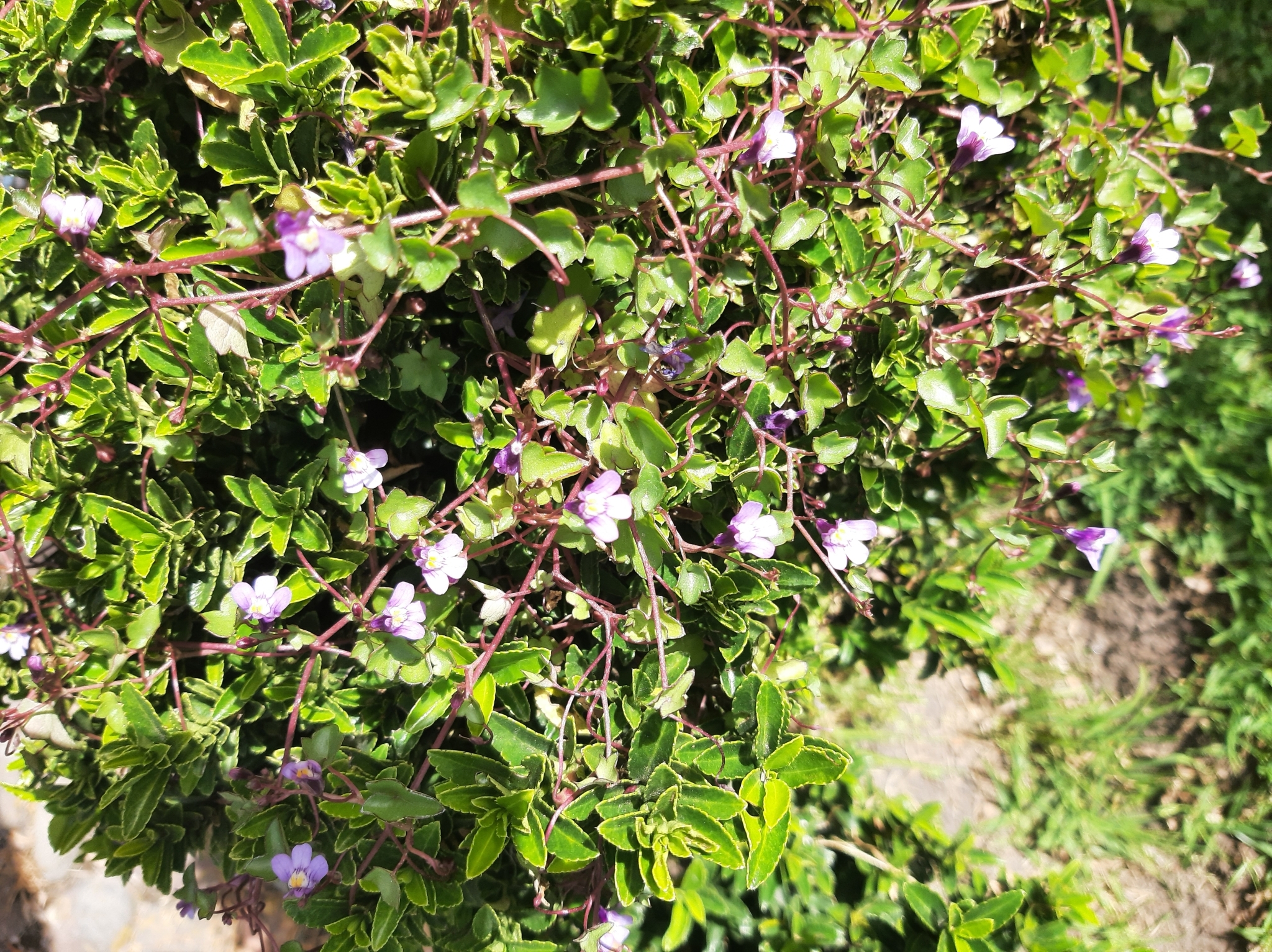
Cymbalaria muralis, commonly called ivy-leaved toadflax, is a low, spreading, trailing plant with small purple flowers, native to rocky habitats in southern Europe. It belongs to the plantain family (Plantaginaceae), and is introduced and naturalised in many other temperate locations. The flower stalk is unusual for seeking light until it is fertilized, after which it grows away from the light. Other names include coliseum ivy, Kenilworth ivy, mother of thousands, Oxford ivy, and wandering sailor.
Description
Cymbalaria muralis spreads quickly, growing 10–80 cm (3.9–31.5 in) tall. It is a biennial or short lived perennial plant. Its roots are thin and fibrous for reaching into cracks. Its rounded, heart-shaped, or kidney shaped leaves are 5–40 mm long, 6–60 mm wide, and are alternating, supported on thin petioles, usually purple, 10–22 mm long. The leaves are either smooth (glabrous) or with widely scattered hairs in the subspecies muralis, or pubescent (villous) in the subspecies visianii. They may have from three to seven lobes, but most often has five lobes. The leaves are relatively thick and often blushed with purple on their undersides.
Cymbalaria muralis has small flowers that strongly resemble those of a snapdragon. They have sepals at the base of the flower that have lobes 1.5–3 mm long and are sharply pointed. The petals form a closed tube 3–5 mm long. The lower lip of the flower expanded upwards to block the tube of the flower similarly to the well known snapdragon flowers (palate inflated). The two cushion shaped parts of the lip under the mouth have yellow spots. The lower lobes of the flower are spreading while the upper ones stand up, with rounded ends and 2–3 mm long. The majority of the flower is lilac with a yellow throat with darker lines on the upper lobes. Rarely the flowers may be all or nearly all white. At the rear of the flower there is a short spur about a third of the total length of...