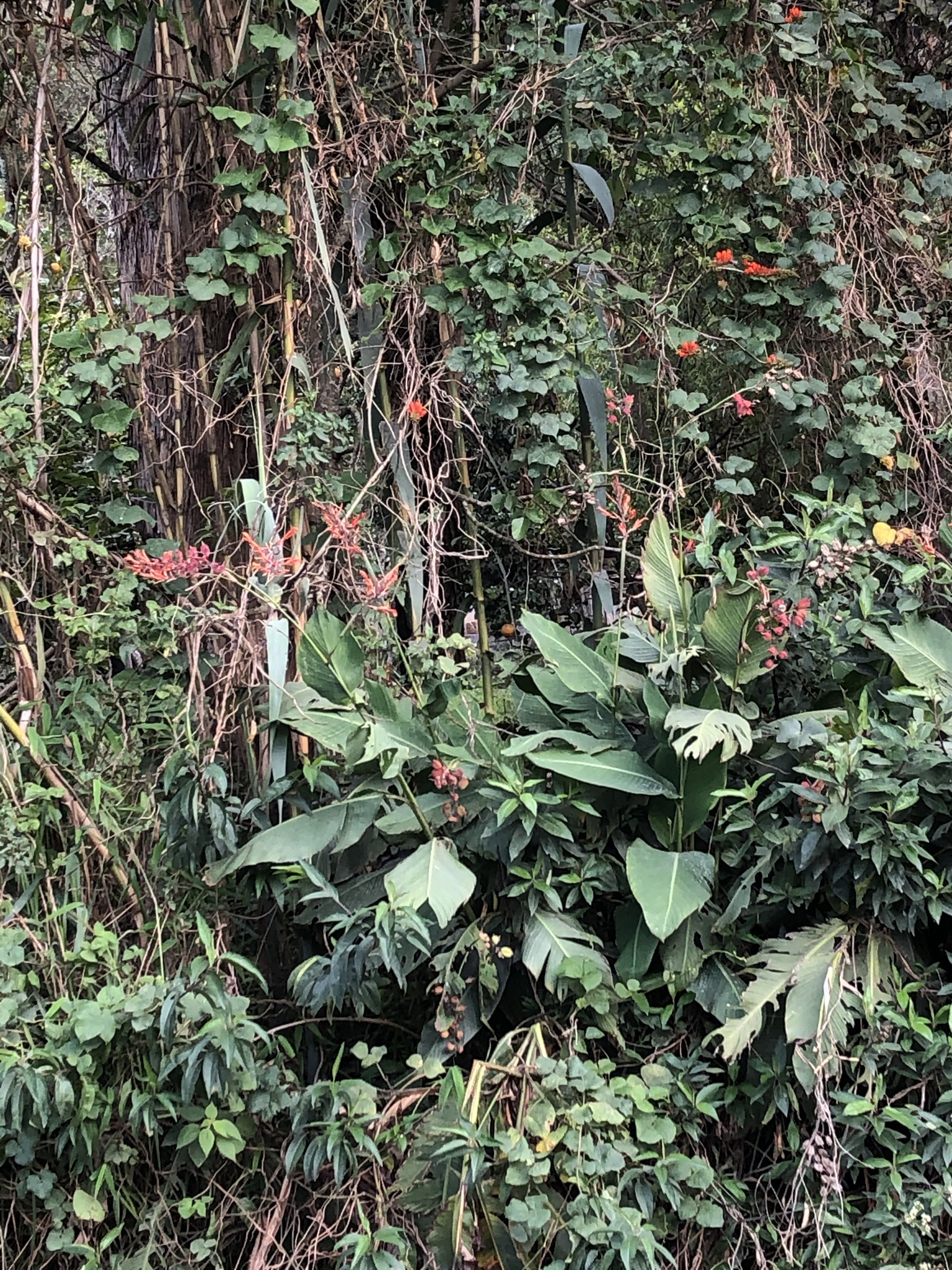
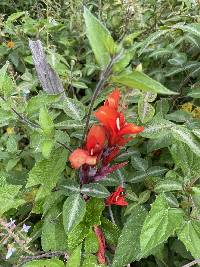
Canna indica, commonly known as Indian shot, African arrowroot, edible canna, purple arrowroot, Sierra Leone arrowroot, is a plant species in the family Cannaceae. It is native to the Americas and naturalized elsewhere. The edible rhizomes are a source of starch.
Description
Canna indica is a perennial growing to between
It forms branched rhizomes 60 centimetres (24 inches) long that are divided into bulbous segments and covered in two lines by pale green or purple flaky leaves. The surface of the rhizome is carved by transverse grooves, which mark the base of scales that cover it. From the lower part white and apex rootlets emerge, where there are numerous buds, the leaves sprout, the floral stem and the stems. The very large grains of starch can supposedly be seen with the naked eye.
The alternate and spiral or two-line arranged, very large, simple leaves are divided into leaf sheaths, short petioles and leaf blades. The leaf blade has a length of 30 to 60 cm (12 to 24 in) and a width of 10 to 20 cm (4 to 8 in). The parallel leaf veins arise from the midrib (not typical of monocots). The leaves are broad, green or violet green, with elliptical sheets, which can measure 30 to 60 cm long and 10 to 25 cm wide, with the base obtuse or narrowly cuneate and the apex is shortly acuminate or sharp.
@media all and (max-width:720px){
Leaves
In bloom
Illustration
Flowers and capsules
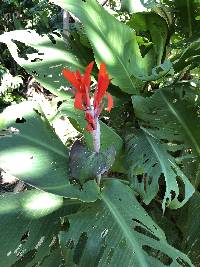
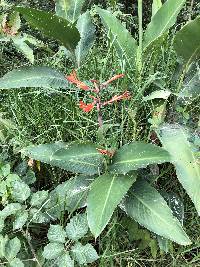
The flowers are hermaphrodite. The mostly large flowers are zygomorphic and threefold. On pedicels, they are 0.2–1 cm (1⁄8–3⁄8 in) long, red or yellow-orange, except in some cultivars, 4.5–7.5 cm (2–3 in) long, with the sepals being closely triangular, 1–1.7 cm (1⁄2–3⁄4 in) long and the petals erect, 4–6.5 cm long. The tube is 1.5–2 cm long.
The bracts are designed differently. The three free sepals are usually green. The...