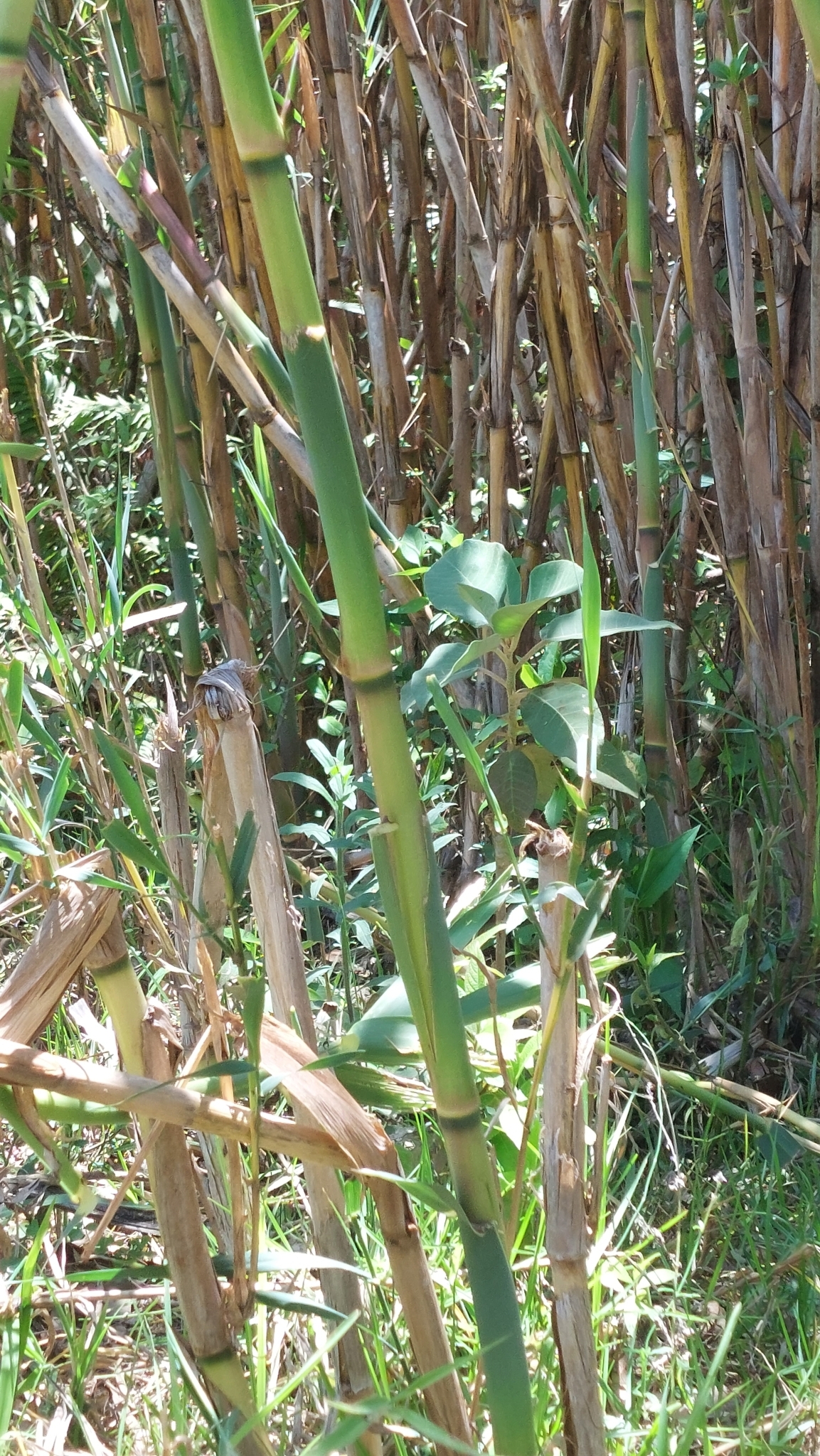
Arundo donax, the giant reed, is a tall perennial reed or cane species. Other vernacular names include giant cane, Spanish cane, wild cane, and in Spanish, carrizo. The scientific name Arundo and donax are respectively the old Latin and Greek names for reed.
Arundo donax grows in damp soils, either fresh or moderately saline, and is native to the eastern Mediterranean region and across southern Asia to Japan. It has been widely planted and naturalised in the mild temperate, subtropical and tropical regions of both hemispheres, especially in the Mediterranean, California, the western Pacific and the Caribbean and is considered invasive in North America and Oceania. It forms dense stands on disturbed sites, sand dunes, in wetlands and riparian habitats.
Description
Arundo donax generally grows to 6 metres (20 ft) in height (in ideal conditions can exceed 10 metres (33 ft)). The hollow stems are 1 to 3 centimetres (0.39 to 1.18 in) in diameter, either unbranched or with small bamboo-like side shoots. The grey-green swordlike leaves are alternate, 30 to 60 centimetres (12 to 24 in) long and 2 to 6 centimetres (0.79 to 2.36 in) wide with a tapered tip, and have a hairy tuft at the base. Overall, the plant resembles an outsize common reed (Phragmites australis) or a bamboo (Poaceae subfamily Bambusoideae).
It flowers in late summer, bearing upright, white feathery plumes 30 to 60 centimetres (12 to 24 in) long, that are usually seedless or with seeds that are rarely fertile. Instead, it mostly reproduces vegetatively by tough, fibrous underground rhizomes that form knotty, spreading mats which penetrate deep into the soil, up to 1 metre (3.3 ft) deep. Stem and rhizome pieces less than 5 centimetres (2.0 in) long and containing a single node could sprout readily under a variety of conditions. This vegetative propagation appears well adapted to floods, which may break up individual A. donax clumps, spreading the pieces, which may...