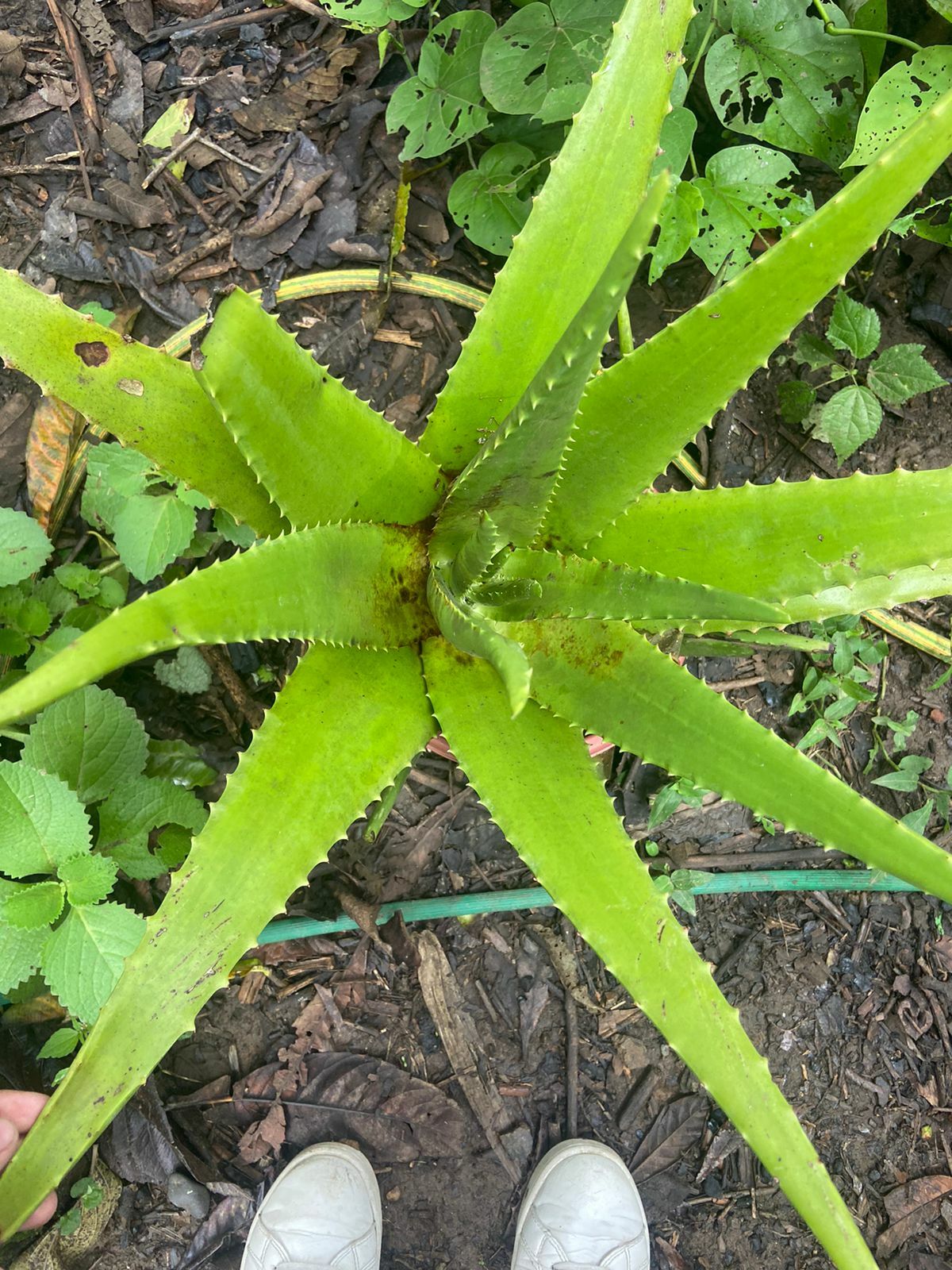
Aloe vera () is a succulent plant species of the genus Aloe. It is widely distributed and is considered an invasive species in many regions of the world.
An evergreen perennial, it originates from the Arabian Peninsula but also grows wild in other tropical, semi-tropical, and arid climates around the world. It is cultivated commercially and has been used for centuries as a topical treatment. The species is considered attractive for decorative purposes and is often used indoors as a potted plant.
The leaves of Aloe vera contain significant amounts of the polysaccharide gel acemannan, which may be used for topical purposes. The leaves also contain aloin, a toxic compound. Aloe vera products are typically made from the gel.
Aloe vera acemannan may be used in skin lotions, cosmetics, ointments, and gels for minor burns, skin abrasions, insect bites, and windburn.
Oral ingestion of aloe vera extracts may cause acute abdominal pain and cramps, and hepatitis if consumed chronically. It should not be used during pregnancy. Some people have allergic reactions to aloe when used on skin.
Etymology
Teeth on the leaf edge
The genus name Aloe is derived from the Arabic word alloeh, meaning "bitter and shiny substance", or from Hebrew אוהלים ahalim, plural of אוהל ahal. The specific epithet vera comes from verus meaning "true" in Latin.
Common names use aloe with a region of its distribution, such as Chinese aloe, Cape aloe, or Barbados aloe.
The species has several synonyms: Aloe barbadensis Mill., Aloe indica Royle, Aloe perfoliata L. var. vera, and Aloe vulgaris Lam. Some literature identifies the white-spotted form of Aloe vera as Aloe vera var. chinensis, and the spotted form of Aloe vera may be conspecific with A. massawana. The species was first described by Carl Linnaeus in 1753 as Aloe perfoliata var. vera. It was described again in 1768 by Nicolaas Laurens Burman as Aloe vera in Flora Indica on 6 April and by Philip Miller as Aloe barbadensis some...