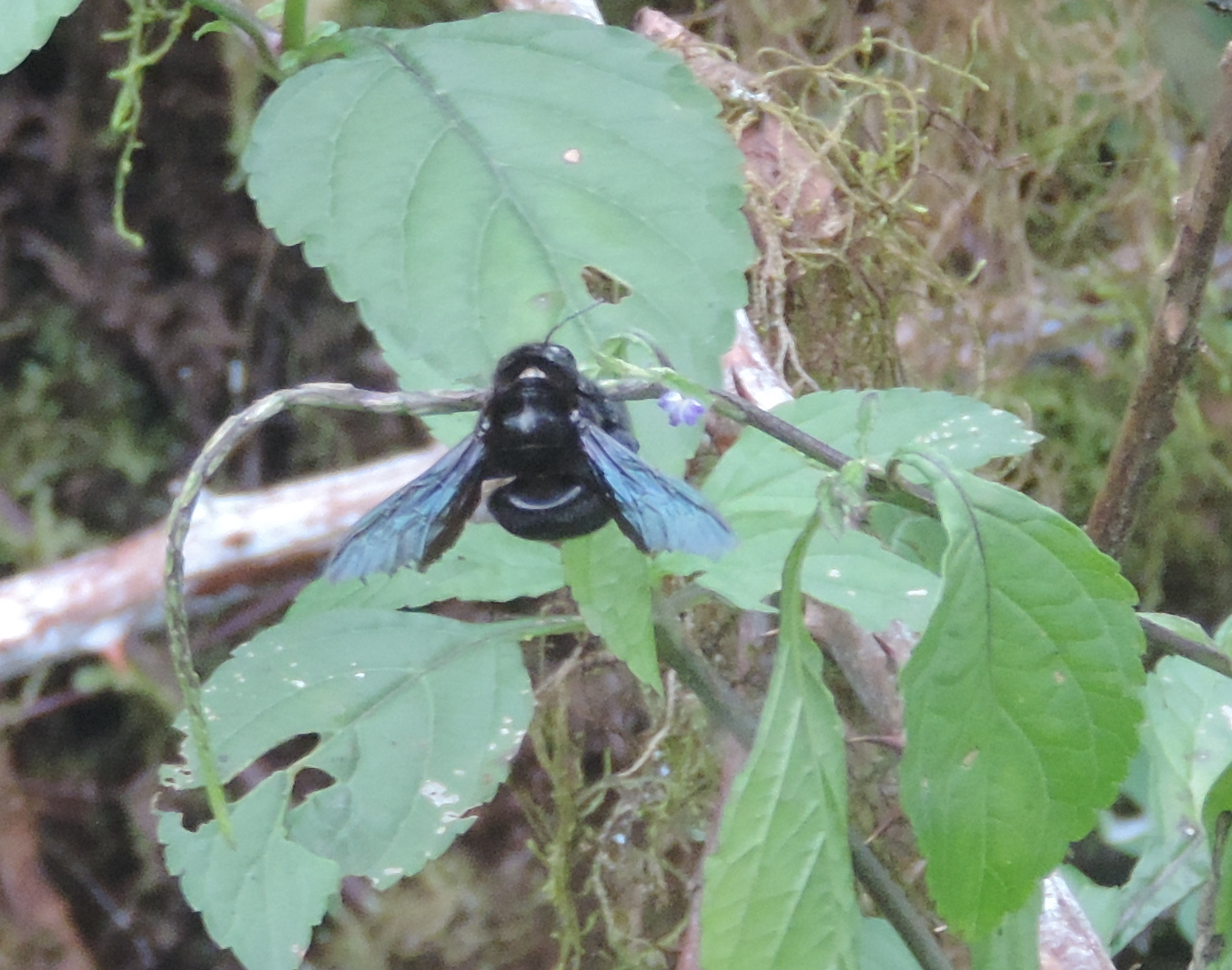
Carpenter bees are species in the genus Xylocopa of the subfamily Xylocopinae. The genus includes some 500 bees in 31 subgenera. Both the scientific name Xylocopa and common name "carpenter bee" derive from their nesting behavior; nearly all species burrow into hard plant material such as dead wood or bamboo. The main exceptions are species in the subgenus Proxylocopa, which dig nesting tunnels in suitable soil.
Linnaeus named the type species Apis violacea 'violet bee' in the Systema Naturae, and Latreille described the genus Xylocopa, romanized Ancient Greek: ξυλοκόπος, lit. 'wood-cutter', in his Natural history, general and particular of the crustaceans and insects, to which the type species was reassigned.
Characteristics
Many species in this enormous genus are difficult to tell apart; most species are all black, or primarily black with some yellow or white pubescence. Some differ only in subtle morphological features, such as details of the male genitalia. Males of some species differ confusingly from the females, being covered in greenish-yellow fur. The confusion of species arises particularly in the common names; in India, for example, the common name for any all-black species of Xylocopa is bhanvra (or bhomora - ভোমোৰা - in Assamese), and reports and sightings of bhanvra or bhomora are commonly misattributed to a European species, Xylocopa violacea; however, this species is found only in the northern regions of Jammu and Kashmir and Punjab, and most reports of bhanvra, especially elsewhere in India, refer to any of roughly 15 other common black Xylocopa species in the region, such as X. nasalis, X. tenuiscapa, or X. tranquebarorum.
Non-professionals commonly confuse carpenter bees with bumblebees; the simplest rule of thumb for telling them apart is that most carpenter bees have a shiny abdomen, whereas bumblebee abdomens are completely covered with dense hair. Males of some species of carpenter bees have a white or yellow face, unlike...