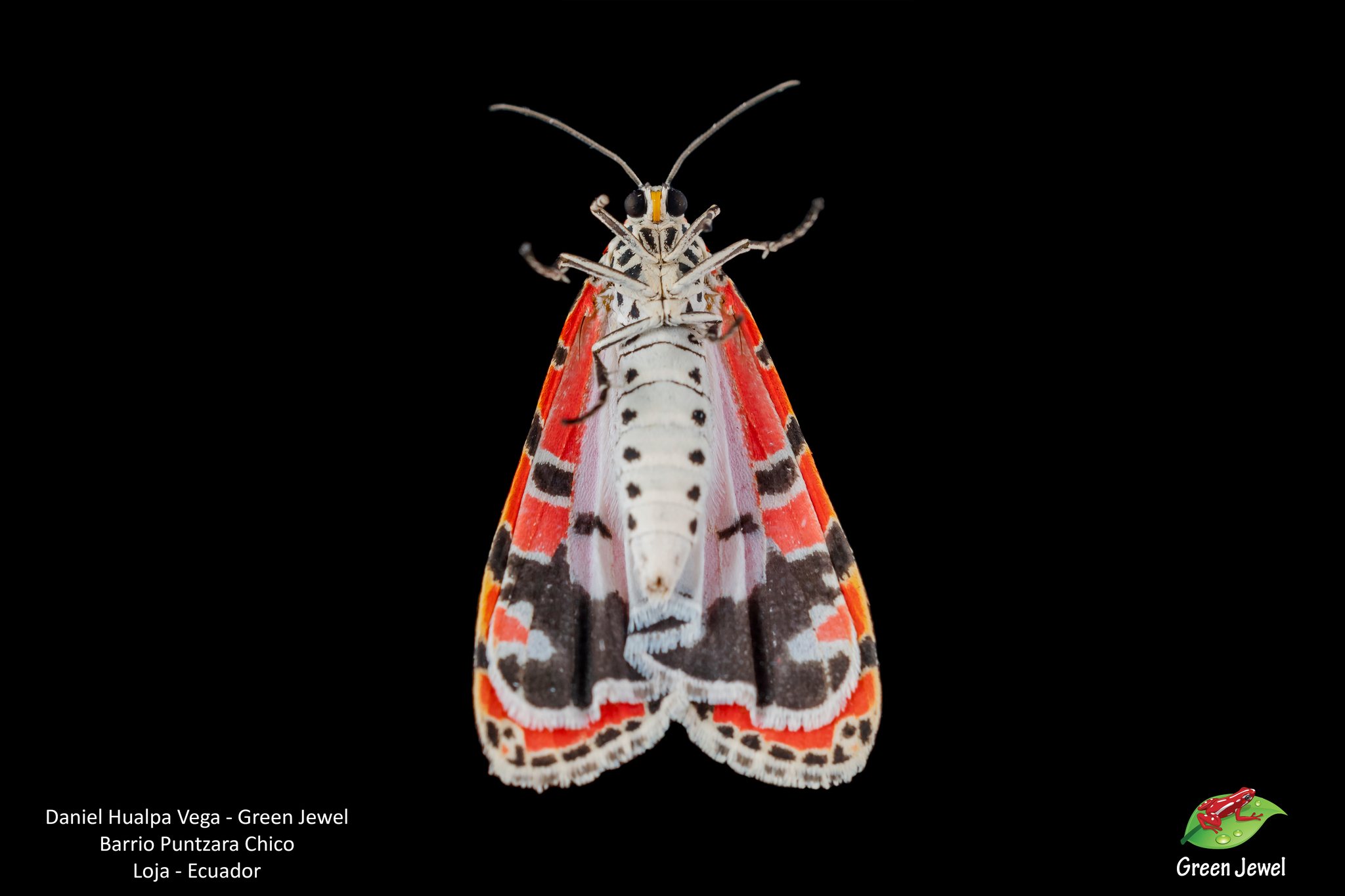
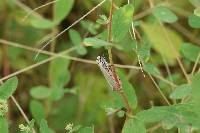
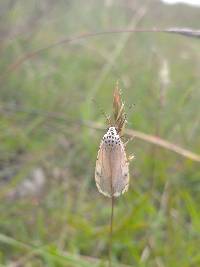
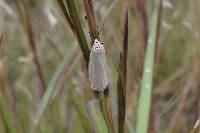
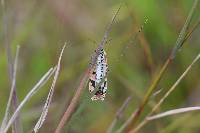
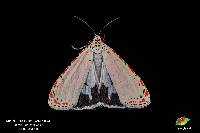
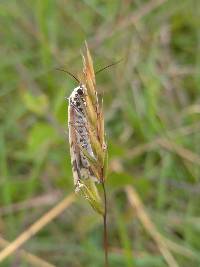
Utetheisa ornatrix, also called the ornate bella moth, ornate moth, bella moth or rattlebox moth, is a moth of the subfamily Arctiinae. It is aposematically colored ranging from pink, red, orange and yellow to white coloration with black markings arranged in varying patterns on its wings. It has a wingspan of 33–46 mm. Moths reside in temperate midwestern and eastern North America as well as throughout Mexico and other parts of Central America. Unlike most moths, the bella moth is diurnal. Formerly, the bella moth or beautiful utetheisa of temperate eastern North America was separated as Utetheisa bella. Now it is united with the bella moth in Utetheisa ornatrix.
The larvae usually feed on Crotalaria species, which contain poisonous alkaloid compounds that render them unpalatable to most predators. Larvae may prey on other bella moth larvae in order to compensate for any alkaloid deficiency.
The bella moth also demonstrates complex mating strategies and is thus an excellent model to study sexual selection. Females mate multiply and receive spermatophores containing sperm, nutrients and alkaloid compounds from numerous males as nuptial gifts. Females choose males according to the intensity of a courtship pheromone, hydroxydanaidal, and carry out a sperm selection process after copulation with various males.
Distribution
Utetheisa ornatrix is found from southeastern United States to South America (southeast Brazil). In the southeastern United States, its distribution ranges from Connecticut westward to southeastern Nebraska and southward to southern New Mexico and Florida. This species is found to be more common in more tropical parts of this range, in accordance to the availability of its host plant in more southern regions. It is also found throughout Mexico, South America, and Central America.