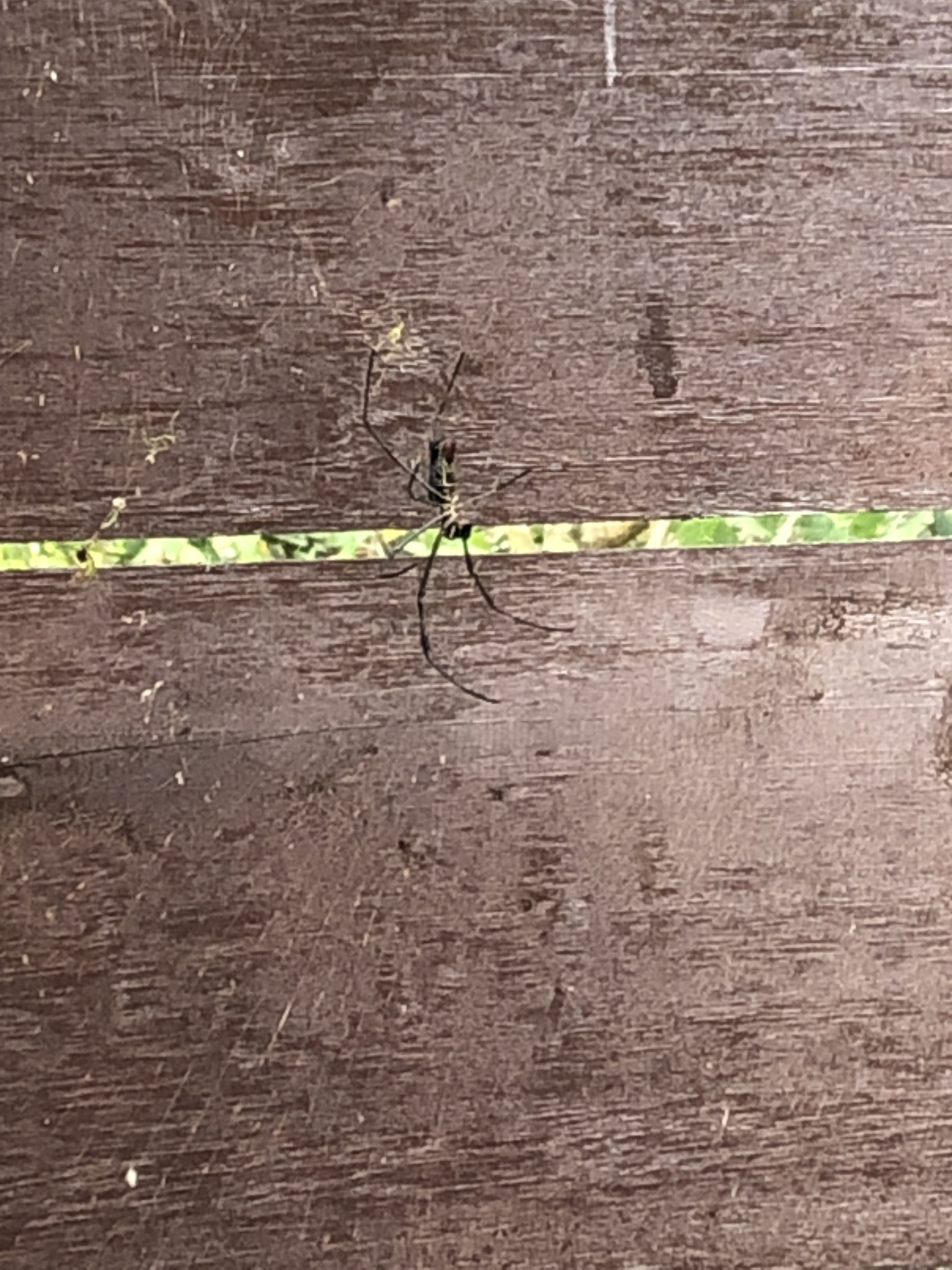
Trichonephila is a genus of golden orb-weaver spiders that was first described by Friedrich Dahl in 1911, as a subgenus of Nephila. Trichonephila was elevated to a genus by Kuntner et al. in 2019.
Distribution and habitat
Trichonephila can be found living in Africa, Oceania, Asia, Central America, the West Indies, South America, and the US' southeastern region and gulf states. These spiders like to make webs where prey is fruitful, often in open wooded areas, between tree branches, shrubs, tall grasses, and around light fixtures. Males are more active in the months of July to September, while the females are most active late into fall.
Behavior
Trichonephila species build large (1–1.5 m) orb webs between trees and shrubs. The viscid spiral of the web is yellowish and the radii are pulled out of their direct course to give it a notched appearance. The supporting lines are very strong and some resistance is felt when one wanders into them. The spiders make use of the same web over long periods, replacing only the viscid lines. In older spiders the web may only be half a circle, while in younger individuals the orb is more complete.
The egg clutches are surrounded by fine puffy silk and are usually laid near the web on surrounding vegetation.
Female spiders are larger and dominate. One reason for the size difference is that following their mating sequence, the females sometimes cannibalize their mating partner. Male spiders fight over female partners, leaving the dominant spider to mate and potentially be killed by the female. Typically, female spiders choose a small male partner.
Courtship dance involves a male mating dance, attempting to attract females. This dance involves multiple functions. To begin the courtship, a male must find a female’s web and make vibrations to let her know he’s not prey. It is common for the male to be mistaken as prey and eaten alive by the females before they mate. The vibrating reduces the risk of aggravating the female....