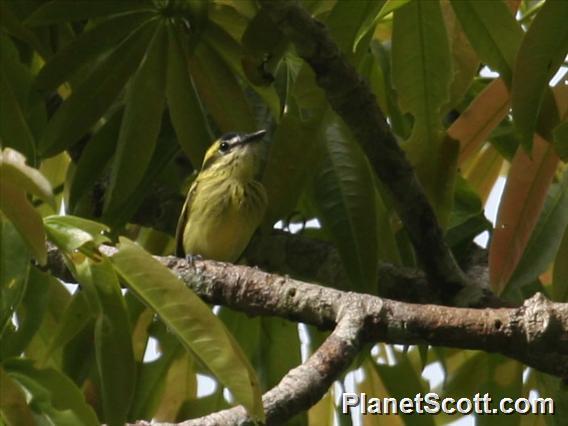
The yellow-browed tody-flycatcher (Todirostrum chrysocrotaphum) is a species of bird in the family Tyrannidae, the tyrant flycatchers. It is found in Bolivia, Brazil, Colombia, Ecuador, and Peru.
Taxonomy and systematics
The yellow-browed tody-flycatcher was originally described in 1850 as a full species with its current binomial Todirostrum chrysocrotaphum.
The yellow-browed tody-flycatcher has these five subspecies:
T. c. guttatum Pelzeln, 1868
T. c. neglectum Carriker, 1932
T. c. chrysocrotaphum Strickland, 1850
T. c. simile Zimmer, JT, 1940
T. c. illigeri (Cabanis & Heine, 1860)
Some mid-twentieth century authors considered the black-headed tody-flycatcher (T. nigriceps) and painted tody-flycatcher (T. pictum) as additional subspecies, but by the 1970s they had regained their status as full species. Several authors treat the three of them as a superspecies. In addition T. c. guttatum was originally described as a full species and continued to be treated that way into the early twentieth century by authors.
Description
The yellow-browed tody-flycatcher is 8.6 to 10 cm (3.4 to 3.9 in) long and weighs about 7 g (0.25 oz). The sexes are alike. Adults of the nominate subspecies T. c. chrysocrotaphum have a mostly black head with a white spot above the lores and a wide yellow supercilium that extends to the nape. A faint narrow yellow band separates their nape from their olive back, rump, and uppertail coverts. Their wings are black with yellow edges on the flight feathers. The wing coverts have thin yellow edges and wide yellow tips; the latter show as two wing bars. Their tail is black. Their underparts are mostly bright yellow with thin black streaks on the side of the throat and across the breast. All subspecies have a dark brown iris, a black bill, and black or dark gray legs and feet.
The other subspecies of the yellow-browed tody-flycatcher differ from the nominate and each other thus:
T. c. guttatum: white chin; heavier black streaks...