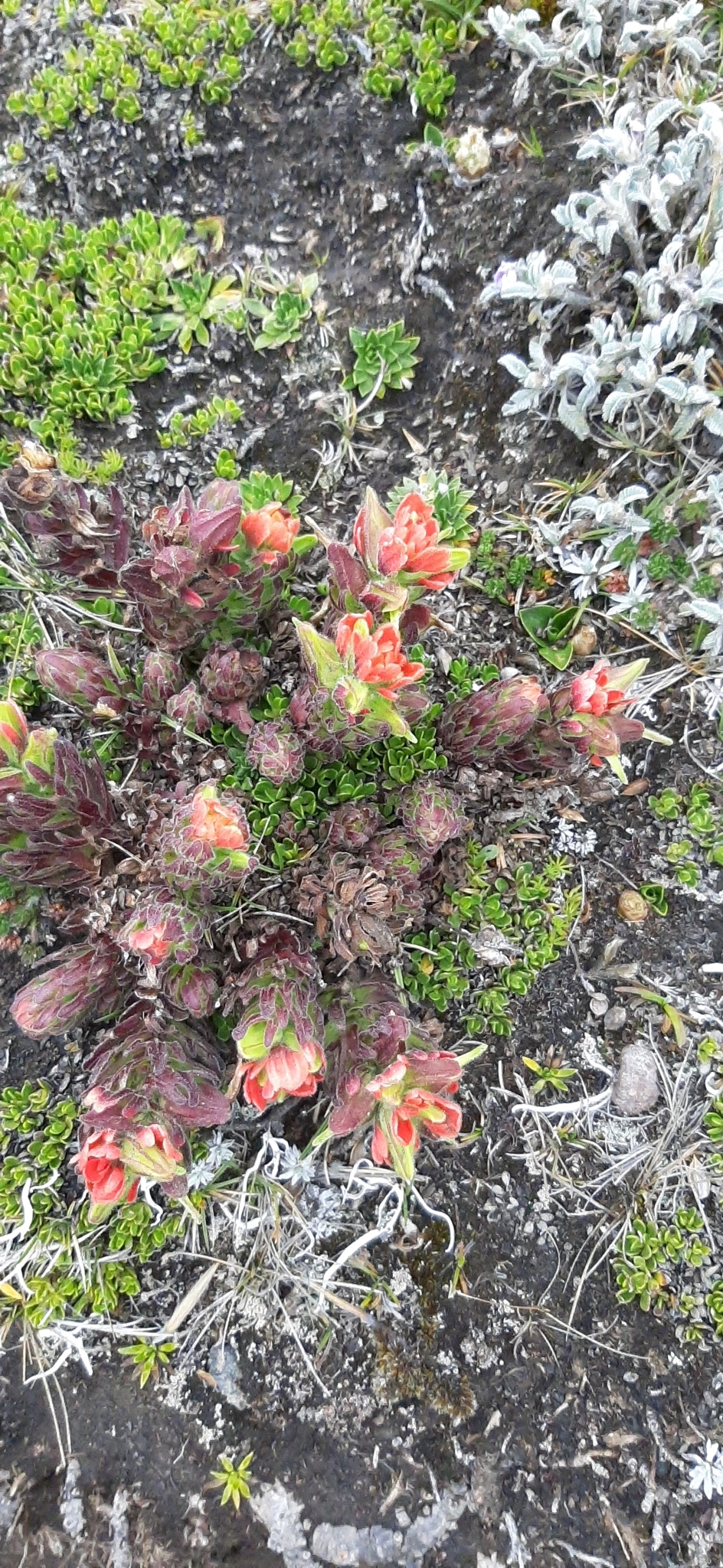
Orobanchaceae, the broomrapes, is a family of mostly parasitic plants of the order Lamiales, with about 90 genera and more than 2000 species. Many of these genera (e.g., Pedicularis, Rhinanthus, Striga) were formerly included in the family Scrophulariaceae sensu lato. With its new circumscription, Orobanchaceae forms a distinct, monophyletic family. From a phylogenetic perspective, it is defined as the largest crown clade containing Orobanche major and relatives, but neither Paulownia tomentosa nor Phryma leptostachya nor Mazus japonicus.
The Orobanchaceae are annual herbs or perennial herbs or shrubs, and most (all except Lindenbergia, Rehmannia and Triaenophora) are parasitic on the roots of other plants—either holoparasitic or hemiparasitic (fully or partly parasitic). The holoparasitic species lack chlorophyll and therefore cannot perform photosynthesis.
Description
Orobanchaceae is the largest of the 20–28 dicot families that express parasitism. Apart from a few non-parasitic taxa, the family displays all types of plant parasitism: facultative parasite, obligate parasite, hemiparasites, and holoparasites.
Parasitic plants are attached to their host by means of haustoria, which transfer nutrients from the host to the parasite. Only the hemiparasitic species possess an additional extensive root system referred to as the lateral or side haustoria. In most holoparasitic species there is a swollen mass of short, bulky roots or one big swollen haustorial organ, which may be simple or composite, commonly called the terminal or primary haustorium.
Plants are reduced to short vegetative stems, their alternate leaves are reduced to fleshy, tooth-like scales, and have multicellular hairs interspersed with glandular hairs.
The hemiparasitic species (transferred from Scrophulariaceae) with green leaves are capable of photosynthesis, and may be either facultative or obligate parasites.
The hermaphroditic flowers are bilaterally symmetrical and grow...