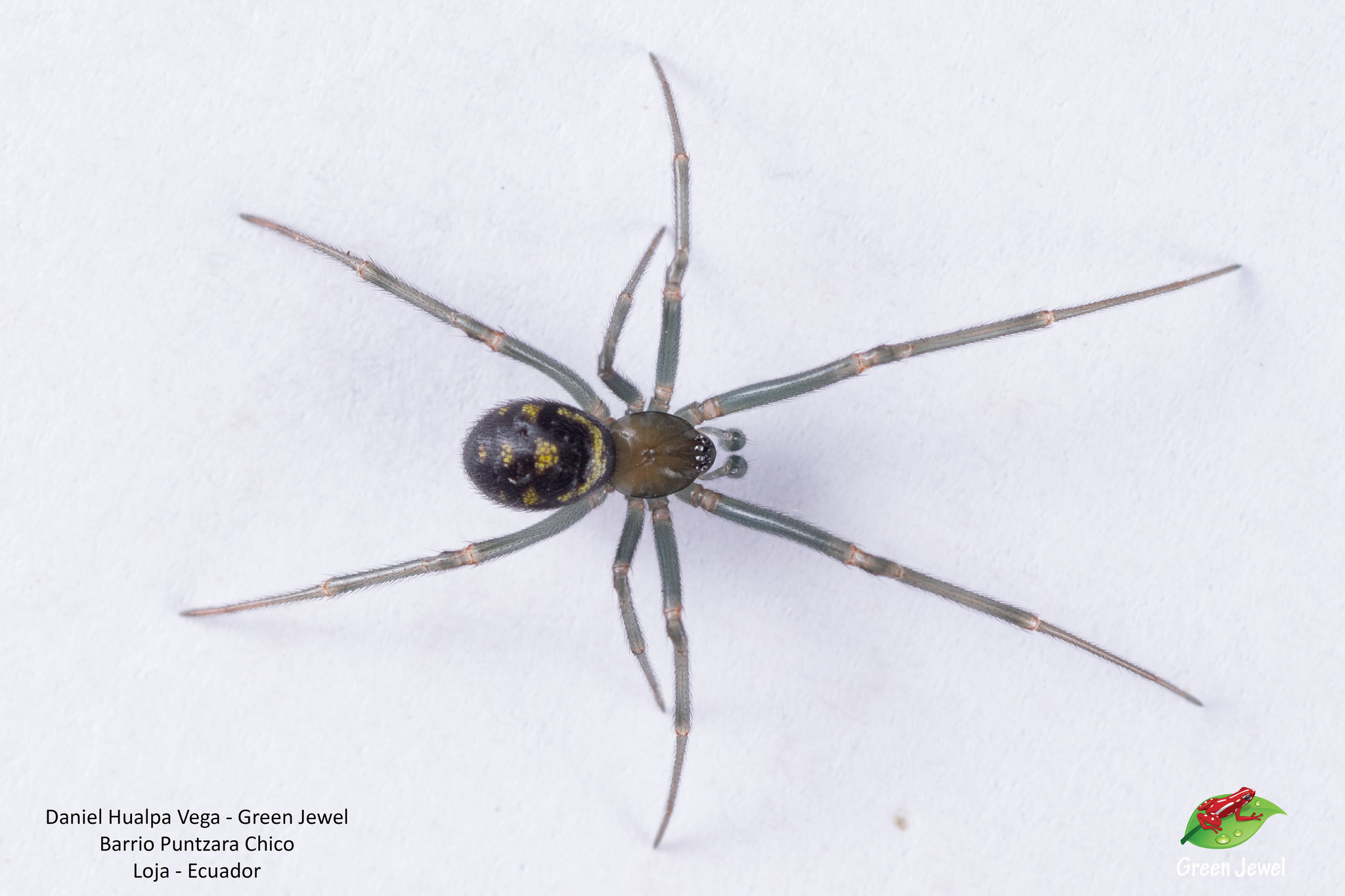
The spider genus Steatoda, in the family Theridiidae, includes about 120 recognized species, distributed around the world (including many cosmopolitan species which are found among human populations worldwide). One common name is cupboard spider, for many species build their webs in dark, sheltered, undisturbed places around the house or garden, in sheds and garages, in compost bins, and in cupboards and dark nooks and corners. Signs of a Steatoda spider include a messy, tangled web with small white spots of spider droppings and insect exoskeletons in the area underneath the web.
Many spiders of the genus Steatoda are often mistaken for widow spiders (Latrodectus), and are known as false widows. The two genera are closely related – both occurring in the same family, Theridiidae – but Steatoda are significantly less harmful to humans. Not all Steatoda species resemble black widows – they come in many different colors and sizes, mostly smaller than Latrodectus species. Steatoda paykulliana can grow larger than the black widow, and Steatoda castanea looks more like a brown widow.
Description
The eye arrangement of spiders in the genus Steatoda
The colour can range from sandy pale brown to reddish plum to satiny black. Like most spiders, its cephalothorax is smaller than its abdomen, which is somewhat egg-shaped, and can have white or beige to orange markings. Although sometimes not or partially visible, these markings usually consists of a frontal crescent, often with a dorsal line or triangular shapes or both. Orange to reddish-marked Steatoda paykulliana can be mistaken for the redback spider).
In common with other members of the family Theridiidae, Steatoda construct a tangled web, i.e., an irregular tangle of sticky silken fibers. These spiders have very poor eyesight and depend mostly on vibrations reaching them through their webs to orient themselves to prey or to warn them of larger animals that could injure or kill them.