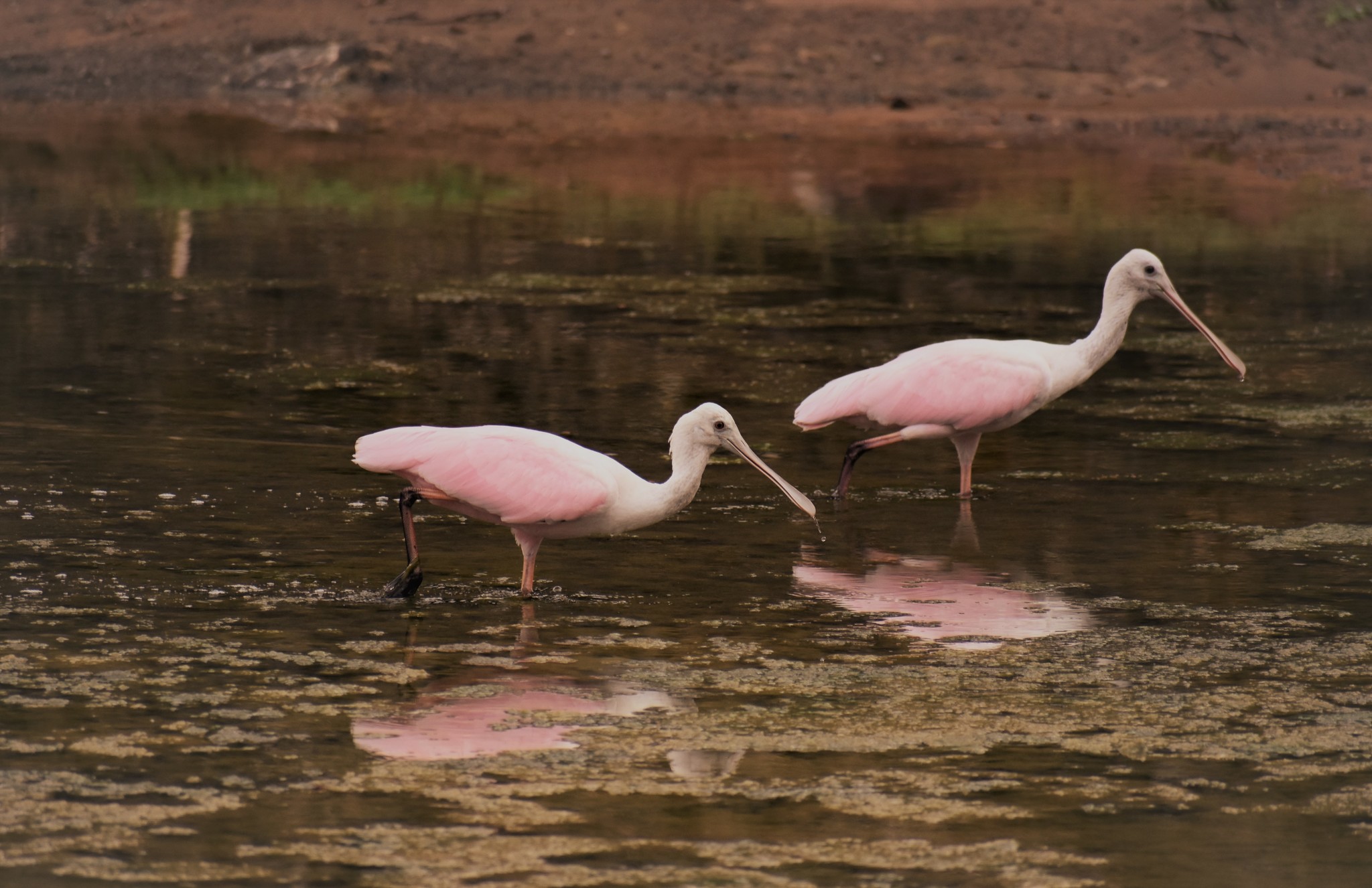
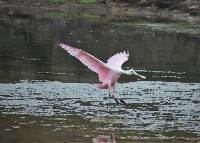
The roseate spoonbill (Platalea ajaja) is a social wading bird of the ibis and spoonbill family, Threskiornithidae. It is a resident breeder in both South and North America. The roseate spoonbill's pink color is diet-derived, consisting of the carotenoid pigment canthaxanthin, like the American flamingo.
Taxonomy
The roseate spoonbill was formally described in 1758 by the Swedish naturalist Carl Linnaeus in the tenth edition of his Systema Naturae under the current binomial name Platalea ajaja. Linnaeus largely based his account on the "Aiaia" that had been described and illustrated over a century earlier by the German naturalist Georg Marcgrave in his book Historia Naturalis Brasiliae. Linnaeus specified the type locality as South America but this is now restricted to Brazil. The genus name Platalea is Latin and means "broad", referring to the distinctive shape of the bill; the specific epithet ajaja is from the name for the species in the Tupi language as reported by Marcgrave. The species is treated as monotypic: no subspecies are recognised.
The roseate spoonbill is sometimes placed in its own genus – Ajaia. A 2010 study of mitochondrial DNA of the spoonbills by Chesser and colleagues found that the roseate and yellow-billed spoonbills were each other's closest relatives, and the two were descended from an early offshoot from the ancestors of the other four spoonbill species. They felt the genetic evidence meant it was equally valid to consider all six to be classified within the genus Platalea or alternatively the two placed in the monotypic genera Platibis and Ajaia, respectively. However, as the six species were so similar morphologically, keeping them within the one genus made more sense.
Description
The roseate spoonbill is 71–86 cm (28–34 in) long, with a 120–133 cm (47–52 in) wingspan and a body mass of 1.2–1.8 kg (2.6–4.0 lb). The tarsus measures 9.7–12.4 cm (3.8–4.9 in), the culmen measures...