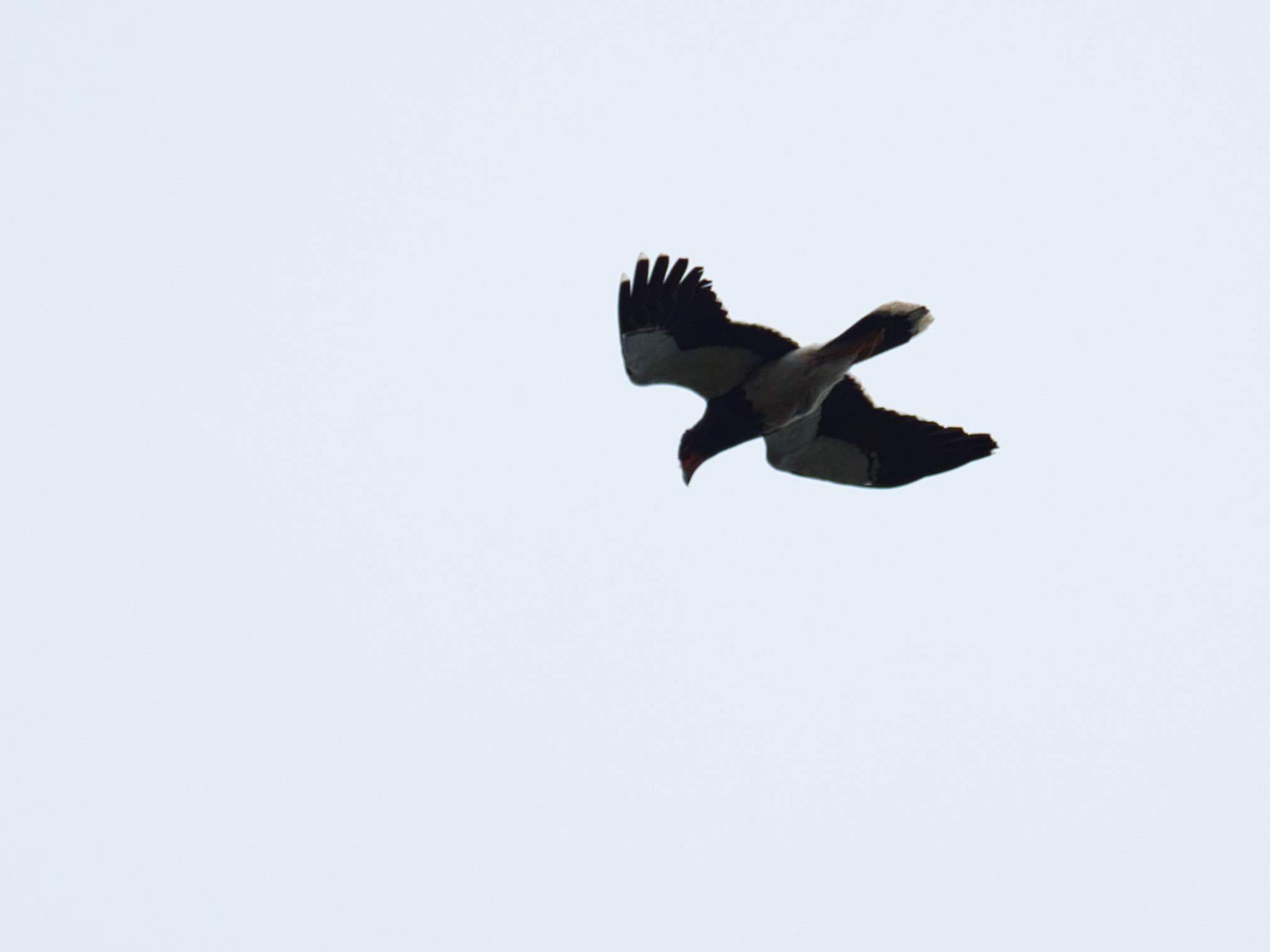
The mountain caracara (Daptrius megalopterus), (Spanish: corequenque) is a species of bird of prey in the family Falconidae. It is found in puna and páramo in the Andes, ranging from northern Ecuador, through Peru and Bolivia, to northern Argentina and Chile. It is generally uncommon to fairly common. It resembles the closely related carunculated caracara and white-throated caracara, but unlike those species, its chest is uniform black. Juveniles are far less distinctive than the red-faced pied adults, being overall brown with dull pinkish-grey facial skin.
Taxonomy
The mountain caracara was formally described and illustrated in 1834 by the Prussian naturalist Franz Meyen under the binomial name Aquila megaloptera based on specimens collect in the Cordillera of Chile. The specific epithet combines the Ancient Greek μεγαλως/megalōs meaning "exceedingly" with -πτερος/-pteros meaning "-winged". The species is monotypic: no subspecies are recognised. The mountain caracara was formerly placed in the genus Phalcoboenus. Molecular genetic studies found that the genus Milvago was polyphyletic with the chimango caracara sister to the genus Phalcoboenus and the yellow-headed caracara sister to the genus Daptrius. As the genetic divergence was relatively shallow, the polyphyly was resolved by expanding the genus Daptrius to include the species formerly placed in the genera Milvago and Phalcoboenus.
Description
A medium-sized caracara with a faintly blue beak tip turning to bright orange, strongly contrasted by the jet-black feathers of its head, back and chest. Its rump, belly and upper tail and undertail coverts are pure white, changing sharply from black to white between the belly and chest. Its black wings have small white shoulder patches and it has white spots on some of its outer primaries. In the 1960s, 17 individual birds were caught and measured and it was noted that the species wing length could range from 358 to 403 mm, giving them a medium-sized wing for...