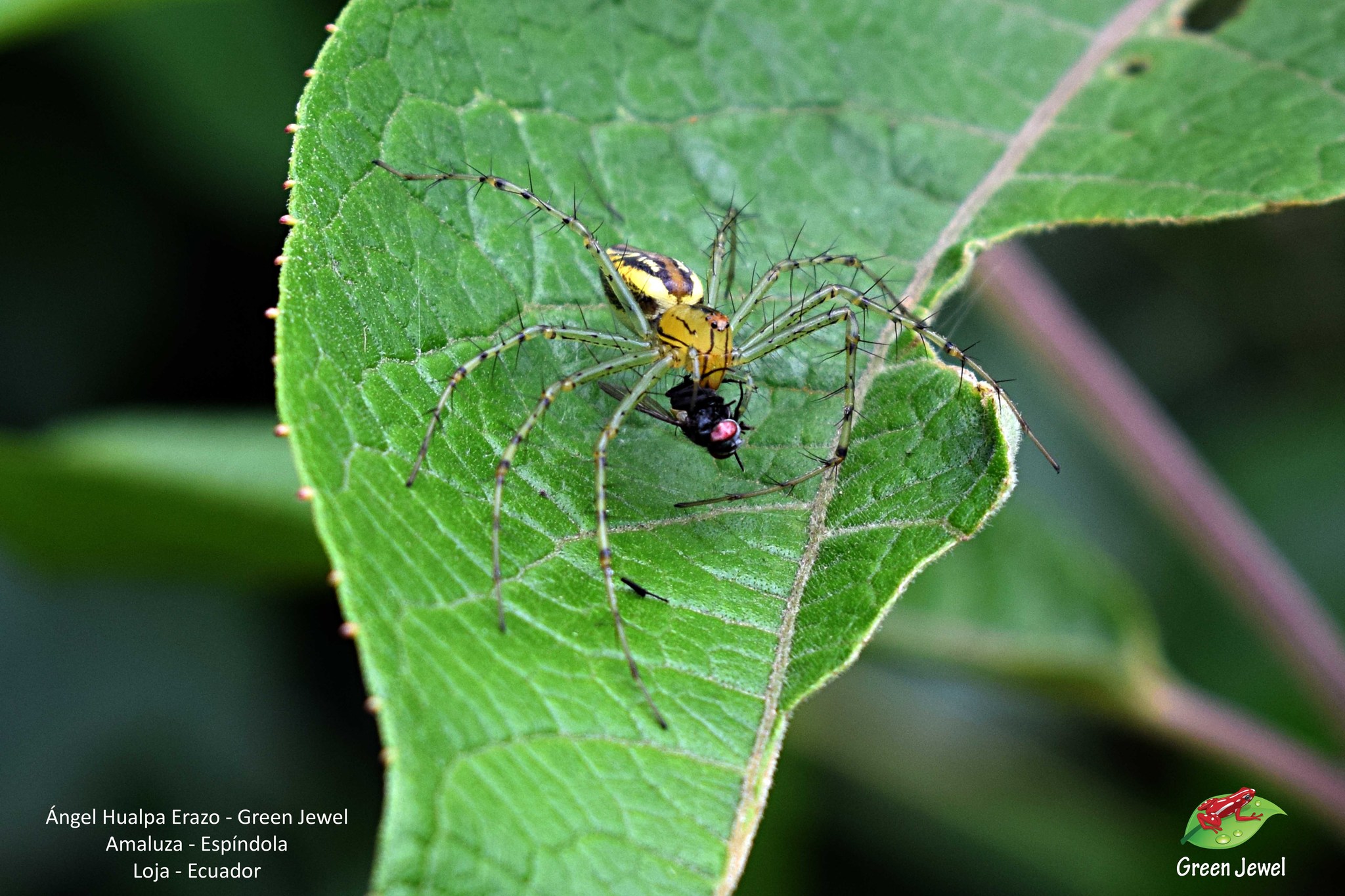
Lynx spiders (Oxyopidae) is a family of araneomorph spiders first described by Tamerlan Thorell in 1870. Most species make little use of webs, instead spending their lives as hunting spiders on plants. Many species frequent flowers, ambushing pollinators, in a manner similar to crab spiders. They tend to tolerate members of their own species more than most spiders do, and at least one species has been observed exhibiting social behaviour.
Description
A Peucetia female, showing the eye pattern and the "flat-faced" appearance typical of the Oxyopidae. In this species the leg bristles are only moderately developed.
Most spiders in the Oxyopidae family have large spiny bristles on their legs and in many species the bristles form almost a basket-like structure that may assist in confining the prey that they grasp, and protect the spider from its struggles. Most Oxyopes and Hamataliwa species are small to medium in size. Lynx spiders, in spite of being largely ambush hunters, are very speedy runners and leapers, alert and with good vision. Oxyopidae in general rely on keen eyesight in stalking, chasing, or ambushing prey, and also in avoiding enemies.
Identification
As with many other families of spiders, the arrangement of their eyes is typical of the family and is an important aid in identifying them as members of the family. Six of the eight eyes of Oxyopid spiders are arranged in a hexagon-like pattern, more or less on a prominent hump on the front upper corner of the prosoma. The other two eyes are smaller, less conspicuous, and generally are situated in front of and below the other six. The basal parts of the chelicerae of most species are large, vertical and parallel, which combine with the bluff front end, a "high forehead" to the prosoma, to give most species a peculiar "flat-faced" appearance.